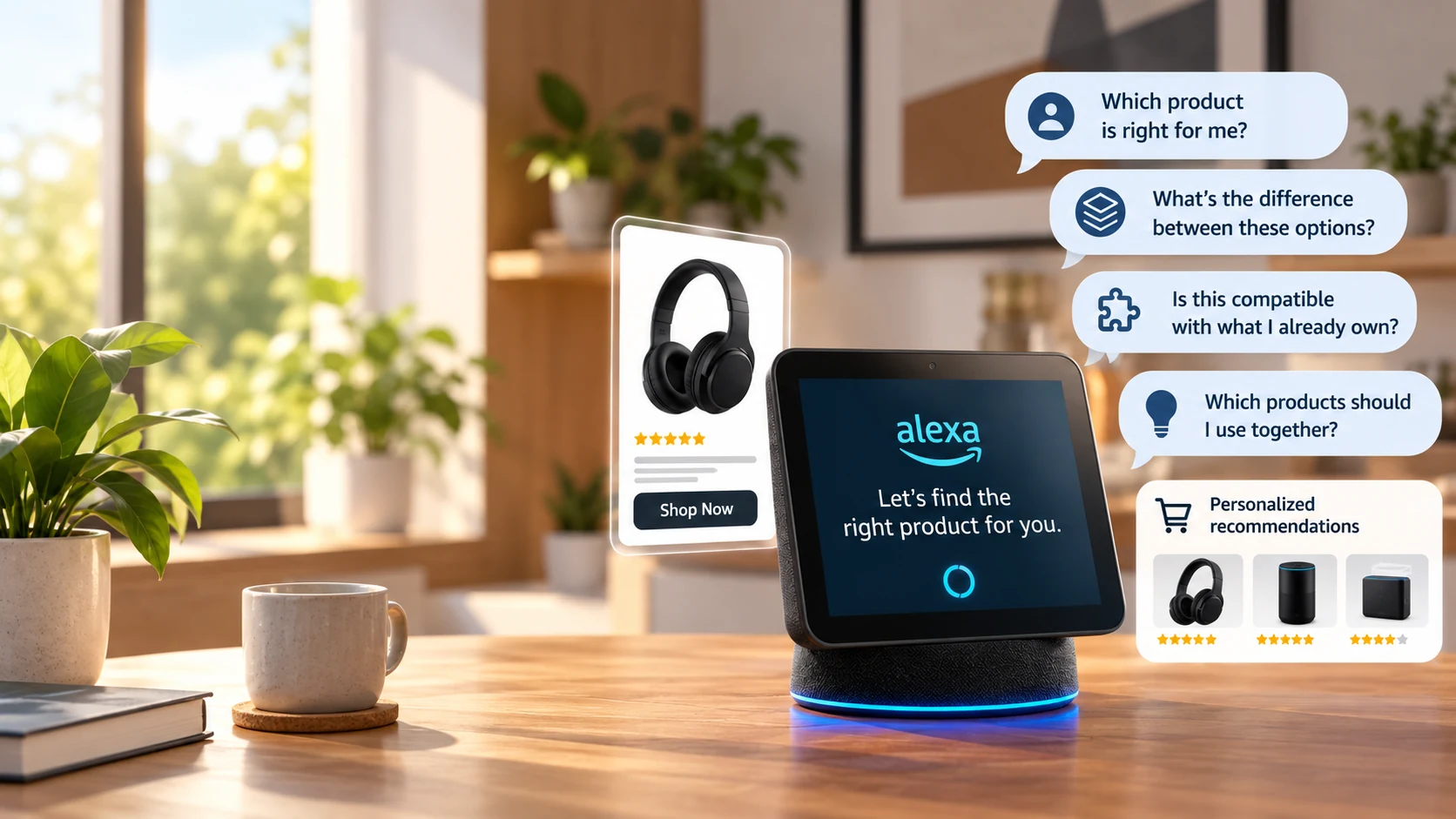

The Future of Amazon SEO: AI Recommendations, Conversational Search, and Buyer Intent
The future of Amazon SEO is moving beyond traditional keyword matching toward a better understanding of customer needs, product relevance, and buyer intent. AI-powered shopping assistants, conversational search, and recommendation systems are changing how customers discover and compare products. For Amazon sellers, the most practical strategy is to combine relevant keywords with accurate product attributes, specific benefits, real-world use cases, and consistent listing information.
How is Amazon SEO changing in 2026?
Amazon SEO has traditionally focused on relevant keywords, product titles, bullet points, descriptions, and conversion performance.
These fundamentals remain important, but AI-powered shopping experiences are introducing new ways for customers to find products.
Instead of searching for "waterproof hiking boots," a customer might ask, "What hiking boots are suitable for walking on wet trails during a weekend trip?"
The second query provides more information about the shopper's situation, preferences, and intended use.
Amazon's AI-powered shopping tools can help customers explore products, compare options, and find recommendations based on these more detailed questions.
For sellers, this means product listings should do more than describe what an item is. They should help shoppers understand who the product is for, what problems it solves, and when it is useful.
Traditional keyword optimization is still necessary, but clear and relevant product information is becoming increasingly valuable.
What role do AI recommendations play in Amazon product discovery?
AI recommendations help customers discover products based on their shopping needs, preferences, and available product information.
Amazon's conversational shopping assistant, originally introduced as Rufus, helps shoppers research products, compare alternatives, and receive personalized recommendations.
Amazon announced that Rufus was renamed Alexa for Shopping in May 2026, although some regional Amazon communications continue using the Rufus name.
According to Amazon's AI shopping overview, these experiences use AI to help customers find and evaluate products through conversational, visual, and personalized shopping tools.
Amazon has also described how its shopping assistant uses information from product catalogs, customer reviews, community questions and answers, shopping context, and other sources.
For example, a shopper might ask:
- "Which laptop stand is suitable for a small home office?"
- "What water bottle is best for daily commuting?"
- "Which backpack has enough space for a 15-inch laptop?"
- "What kitchen storage products work well in small apartments?"
AI shopping assistants can use product details and shopping context to help shoppers evaluate relevant options.
However, Amazon has not publicly disclosed the complete rules determining which products appear in AI-generated recommendations.
Sellers should therefore focus on accurate, useful content rather than assuming a particular keyword or formatting trick will guarantee AI visibility.
(Related reading: How to Optimize Your Amazon Listings for Rufus and AI Shopping Assistants)
Why is buyer intent becoming more important for Amazon SEO?
Buyer intent describes the reason behind a customer's search and what they hope to accomplish with a purchase.
Understanding buyer intent helps sellers create listings that address actual customer needs instead of simply repeating popular keywords.
For example, someone searching for "portable laptop stand" may be looking for a lightweight accessory suitable for travel.
Another customer searching for "laptop stand for home office" may be more interested in adjustable height, stability, and desk organization.
Both customers are searching for laptop stands, but their purchasing priorities are different.
Amazon's COSMO research provides an example of how AI can identify relationships between customer needs, shopping behavior, and product characteristics.
Published in 2024, Amazon's COSMO research describes a commonsense knowledge system that has been deployed in search applications, including search navigation.
This research demonstrates the importance of understanding why customers need particular products.
However, COSMO should not be treated as a publicly documented replacement for Amazon's broader ranking systems.
For sellers, the practical approach is to match relevant keywords with clear descriptions of product benefits and appropriate use cases.
(Related reading: Amazon COSMO Algorithm Explained: How to Optimize Listings for Customer Intent)
What is conversational search, and how does it affect Amazon sellers?
Conversational search allows customers to ask detailed shopping questions using natural language instead of relying entirely on short keyword phrases.
Traditional product searches often focus on product names and specific features.
Conversational searches may include additional requirements such as budget, compatibility, intended use, personal preferences, and purchasing concerns.
For example, a customer could search for "noise-canceling headphones" or ask, "Which headphones are comfortable for long flights and help reduce background noise?"
Both queries relate to the same product category, but the conversational query explains more about the customer's expectations.
For Amazon sellers, this creates an opportunity to address common purchasing questions throughout their listings.
Product descriptions should clearly explain what the product offers and how its verified features relate to customer needs.
Accurate, specific information can make listings more useful for shoppers comparing products.
A practical Amazon SEO checklist for AI-powered shopping
1. Understand what your customers are searching for
Start by identifying the questions, problems, and buying situations associated with your products.
Review relevant Amazon search terms, customer feedback, product questions, and advertising performance.
Eligible brands can use Amazon Brand Analytics to understand search activity, discover relevant keywords, and review customer engagement.
Focus on identifying both product-related keywords and the needs behind those searches.
For example, customers shopping for backpacks may prioritize laptop compatibility, storage space, travel convenience, or carrying comfort.
Use these insights to make your listing more relevant to the audience it serves.
2. Complete all relevant product attributes
Accurate product attributes provide important information about an item's specifications and intended use.
Complete relevant Seller Central fields, including material, dimensions, size, color, compatibility, capacity, and special features.
For example, an office chair listing should accurately describe its materials, adjustable features, dimensions, and weight capacity.
Missing product attributes can make it more difficult for customers to compare products or confirm suitability.
Make sure information remains consistent across your title, bullet points, images, and product description.
3. Write product titles for clarity and search relevance
An effective Amazon product title should clearly identify the item and communicate its most important attributes.
Include relevant keywords naturally while following Amazon's category-specific title requirements.
A title should provide enough information for shoppers to understand the product without unnecessary repetition.
For example, instead of using a vague title such as "Premium Laptop Stand for Office," a seller could identify the product's material, compatible laptop sizes, and adjustable design, provided those details are accurate.
Avoid keyword stuffing and exaggerated promotional claims.
Clear product titles support both traditional product discovery and customer understanding.
4. Create bullet points that answer buyer questions
Bullet points should explain product features and connect them to meaningful customer benefits.
Instead of simply writing "Adjustable height," explain how the feature can support different desk setups.
For example: "Adjustable height settings allow users to position the laptop at different levels for desk-based work."
The strongest bullets answer common customer questions about compatibility, convenience, materials, durability, and intended use.
Keep every claim specific and supported by the product's actual features.
5. Use A+ content to explain product use cases
Amazon A+ content gives eligible sellers additional space to showcase their products using enhanced images, text, videos, and comparison modules.
Use this space to explain how a product works, highlight important features, and demonstrate real-world applications.
For example, a travel backpack listing might include sections describing storage compartments, laptop compatibility, carrying options, and dimensions.
Comparison charts can also help shoppers understand differences between product variations.
Well-organized A+ content supports informed purchasing decisions.
However, Amazon has not publicly confirmed that every A+ content element directly influences AI recommendation placement.
6. Optimize product images for better understanding
Product images remain essential because customers need to see what they are purchasing.
Use high-quality images that accurately represent the item, its dimensions, features, and included accessories.
Secondary images can demonstrate appropriate use cases, product details, and size comparisons.
For example, a laptop bag listing could show the product from different angles, its internal compartments, and its fit with a compatible laptop.
Ensure your main image and supporting images follow Amazon's applicable image requirements.
Clear visuals help customers evaluate products and become increasingly relevant as AI-powered visual shopping experiences develop.
7. Use customer reviews to identify missing information
Customer reviews provide valuable insights into the features shoppers appreciate and the concerns they experience.
Look for recurring questions about sizing, materials, compatibility, product performance, and usability.
Use those insights to identify information that should be explained more clearly in your listing.
For example, if customers frequently ask whether a product fits a particular device, consider adding verified compatibility details.
Negative reviews can also reveal confusing descriptions or unrealistic customer expectations.
Do not manipulate reviews or make unsupported claims based on individual feedback.
8. Combine organic SEO with PPC and conversion optimization
Listing optimization works best when supported by strong Amazon advertising and account fundamentals.
Relevant PPC campaigns can help sellers reach customers actively searching for related products.
Monitor advertising search terms to identify queries that lead to clicks and purchases.
Use those insights to improve listing relevance and refine campaign targeting.
Competitive pricing, inventory availability, delivery options, customer experience, and account health also remain important.
Better product content can support conversion performance, but it does not guarantee lower advertising costs or higher organic rankings.
(Related reading: Amazon PPC fundamentals)
How can sellers optimize listings for AI recommendations and GEO?
Generative Engine Optimization, or GEO, focuses on making information clear, accurate, and useful for AI-powered systems that generate answers and recommendations.
For Amazon sellers, this means creating product information that answers common buyer questions directly.
The most useful details include:
- Who the product is designed for.
- What problem the product solves.
- Which materials and features it includes.
- What devices or accessories it is compatible with.
- Which situations or environments it is suitable for.
- What limitations customers should understand before purchasing.
For example, a listing for an insulated water bottle should explain its actual capacity, construction, lid design, dimensions, and verified temperature-retention performance.
This information can help shoppers determine whether it is suitable for commuting, travel, or outdoor activities.
The goal is not to create copy that sounds artificially optimized for AI.
Instead, sellers should communicate product information in a way that is easy for customers to understand and verify.
GEO complements Amazon SEO, but neither approach offers guaranteed placement in AI-generated recommendations.
Common mistakes Amazon sellers should avoid
One of the biggest mistakes is assuming traditional Amazon SEO no longer matters.
Relevant keywords, accurate product information, and conversion fundamentals remain important.
Other common mistakes include keyword stuffing, publishing vague product descriptions, leaving important attributes incomplete, and adding unsupported product claims.
Some sellers also copy competitor listings without considering their own customers' needs.
Another mistake is assuming that mentioning Rufus, COSMO, or AI-related keywords automatically improves product visibility.
There is no publicly documented shortcut that guarantees recommendations from Amazon's AI shopping systems.
The better approach is to create relevant, consistent, and trustworthy product content.
How can sellers measure Amazon SEO improvements?
Amazon sellers should evaluate listing changes using measurable performance data rather than relying on assumptions about AI visibility.
Useful metrics include click-through rate, conversion rate, impressions, sessions, and sales.
Eligible brands can use Amazon Brand Analytics to evaluate Search Query Performance, including impressions, clicks, cart adds, and purchases.
Amazon's Manage Your Experiments tool also allows eligible sellers to test different versions of product listing content.
These tests can help determine whether changes to titles, images, bullet points, or A+ content improve customer response.
Evaluate results over a meaningful period rather than expecting immediate ranking changes.
There is no publicly confirmed timeline for achieving improved visibility through AI recommendations or conversational search.
Frequently Asked Questions About the Future of Amazon SEO
Is Amazon SEO still important in 2026?
Yes. Amazon SEO remains important for helping shoppers discover relevant products. AI-powered shopping experiences add new ways to explore and compare products, but relevant keywords, accurate attributes, strong listings, and conversion performance remain valuable.
Will AI replace traditional Amazon product search?
Amazon is expanding conversational and AI-powered shopping experiences, but this does not mean traditional product search will disappear. Sellers should optimize for both keyword-based discovery and detailed customer questions.
What is the difference between Amazon SEO and GEO?
Amazon SEO focuses on improving product relevance, discoverability, and performance within Amazon's shopping environment. GEO focuses on making information useful and understandable to AI-powered answer and recommendation systems. Both benefit from accurate, well-structured product information.
Does Amazon COSMO control all product recommendations?
Amazon has documented COSMO as a commonsense knowledge system used in search applications, including search navigation. It has not publicly confirmed that COSMO controls every product ranking or recommendation.
How can sellers improve visibility in AI shopping recommendations?
Sellers can improve product clarity by completing accurate attributes, writing detailed descriptions, answering common buyer questions, maintaining consistent claims, and improving the overall customer experience. These practices support product understanding but cannot guarantee inclusion in AI recommendations.
Final Thoughts
The future of Amazon SEO is increasingly connected to customer intent, conversational shopping, and AI-powered product discovery.
For sellers, the strongest strategy is not to abandon traditional optimization techniques but to improve them with clearer product information and a deeper understanding of customer needs.
Relevant keywords help shoppers discover products, while accurate features, meaningful benefits, and real-world use cases help them evaluate purchasing decisions.
As Amazon continues developing its AI-powered shopping experiences, sellers who focus on clarity, relevance, and customer trust will be better prepared to adapt.
Need a second set of eyes? Our team at Adorbix helps Amazon sellers improve listing content, strengthen SEO strategies, and prepare product pages for evolving AI-powered shopping experiences. Reach out any time to discuss your listing.
Key Takeaways
- Amazon SEO is evolving alongside AI recommendations, conversational search, and buyer-intent understanding.
- Traditional keywords remain important, but product benefits and real-world use cases deserve greater attention.
- Accurate attributes and clear descriptions help customers evaluate products.
- Customer reviews, Q&A, and search analytics can reveal opportunities for listing improvements.
- A+ content and high-quality product images support product understanding and conversion.
- GEO complements traditional Amazon SEO but does not guarantee AI recommendation placement.
- Track CTR, conversion rates, impressions, and sales to measure listing performance.
- Questions? Contact Adorbix for an Amazon listing audit.

.webp)