



Sam
Amazon
September 18, 2026
Amazon’s New Coupon Workflow Auto-Save Cloning and Q4 Strategy Adorbix
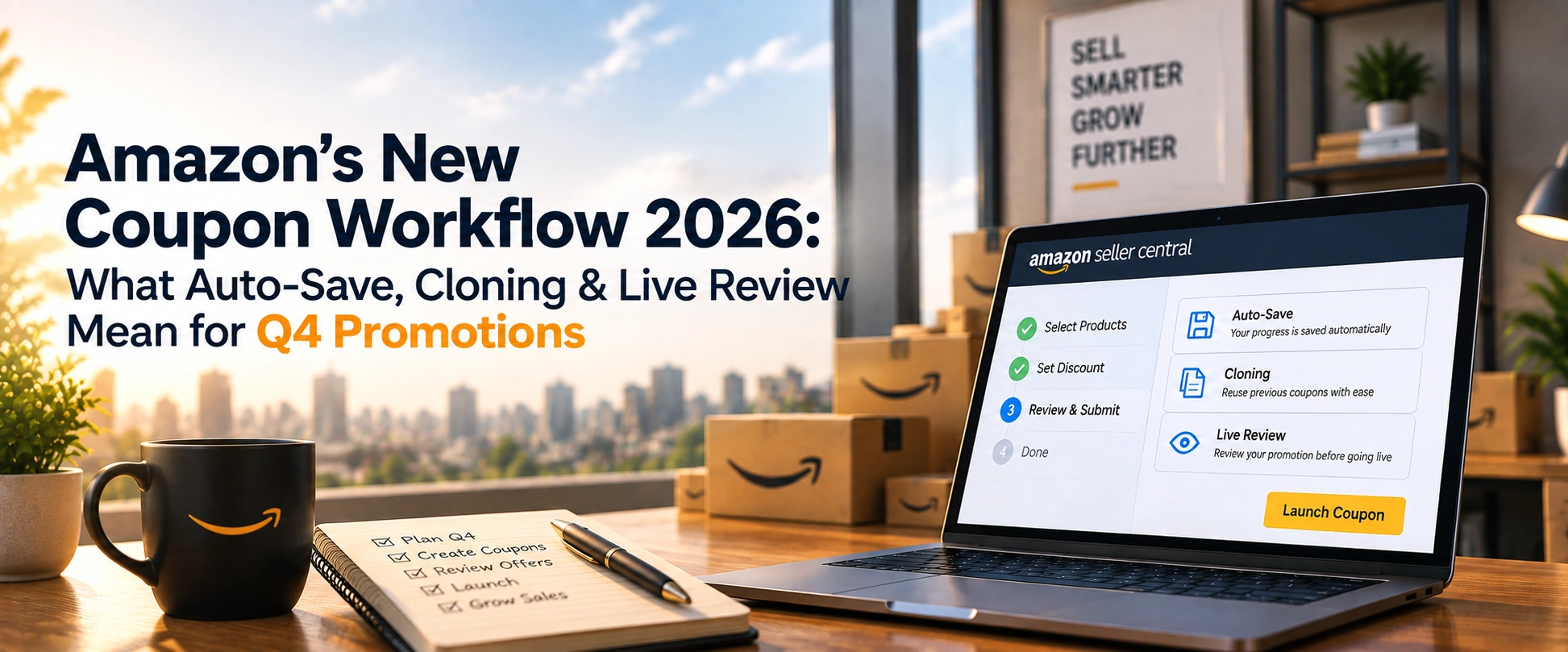
Amazon’s New Coupon Workflow 2026: What Auto-Save, Cloning & Live Review Mean for Q4 Promotions
Amazon has quietly made coupon creation in Seller Central much easier—and the timing could not be better for sellers preparing for Q4.
The updated coupon workflow now includes four practical improvements:
- Automatic draft saving
- A full review screen before submission
- The ability to clone previous coupons
- A step tracker showing where you are in the setup process
Amazon says the redesigned experience is intended to reduce the friction involved in creating promotions, especially for sellers managing coupons across multiple stores or running repeated campaigns. (Amazon Seller Central)
None of these features fundamentally changes what a coupon is.
But together, they change how efficiently sellers can build, review, replicate, and manage promotions.
And during Q4—when teams may be coordinating dozens of ASINs, discount levels, campaigns, marketplaces, inventory plans, and ad budgets—reducing setup errors can have real financial value.
At Adorbix, we would treat this update as more than a Seller Central UX improvement.
It creates an opportunity to build a more disciplined promotion workflow:
PLAN → CLONE → VERIFY → LAUNCH → MEASURE
Because creating coupons faster is useful.
Creating the right coupons profitably is what matters.
What Exactly Changed in Amazon’s Coupon Workflow?
Amazon's September 2026 update focuses on four areas.
1. Auto-Save Drafts
Your coupon setup now saves automatically as you work.
If you:
- Close the browser
- Get interrupted
- Need approval from another team member
- Come back later
the draft should remain available instead of forcing you to restart the promotion. (Amazon Seller Central)
This sounds small until you're managing:
5 campaigns.
50 campaigns.
Or multiple marketplaces.
For larger brands and agencies, lost work creates both operational inefficiency and human error.
Auto-save makes coupon creation feel more like a proper campaign workflow rather than a one-session form.
2. Review Everything Before Submission
Amazon has added a clearer review step that summarizes the coupon configuration—including the products included in the promotion—before the campaign goes live. (Amazon Seller Central)
This is one of the most valuable improvements.
Why?
Because coupon mistakes can be expensive.
Imagine intending to discount:
ASIN A
but accidentally including:
ASIN A + B + C.
Or intending:
10% off
but configuring:
20% off.
Or applying a promotion to an ASIN whose margin cannot support the discount.
A proper pre-launch review gives sellers another chance to catch:
- Wrong ASINs
- Wrong variations
- Incorrect discount level
- Incorrect duration
- Catalog-selection mistakes
Q4 is not the time to discover a promotion error after customers already redeemed it.
3. Clone Previous Coupons
Amazon now allows sellers to reuse the inputs from previous coupons as a starting point rather than rebuilding a similar promotion from zero. (Amazon Seller Central)
This is particularly useful for brands that repeatedly run promotions across:
- Seasonal campaigns
- Product launches
- Monthly sales
- Multiple marketplaces
- Similar ASIN groups
For example:
September Coupon
10% off
5 hero ASINs
7 days
Then for October, instead of recreating everything manually:
Clone → Update date → Adjust discount → Review → Submit
That can significantly reduce setup time.
But cloning also introduces a new risk:
Copying yesterday’s assumptions into today’s campaign.
Before cloning a promotion, recheck:
- Current price
- Current margin
- inventory
- eligibility
- ASIN status
- promotional objective
Cloning should save administrative work.
It should not eliminate strategic thinking.
4. A Step Tracker Shows What’s Left
The new workflow also includes a progress tracker showing which stage of coupon creation you're currently in and what still needs to be completed. (Amazon Seller Central)
This is especially useful for:
- New sellers
- Large catalogs
- Agency teams
- Multi-step approvals
Instead of guessing whether the setup is complete, sellers get a clearer visual workflow.
For Q4, that can support much better standardization across teams.
Why This Matters More During Q4
Q4 coupon management becomes complicated quickly.
Your business may simultaneously be preparing for:
- Prime-related events
- Black Friday
- Cyber Monday
- Holiday gifting
- December promotions
- Overstock sell-through
- New-product launches
Every promotion can have different:
- ASINs
- margins
- inventory levels
- dates
- PPC support
- business objectives
The operational risk isn't simply:
“We forgot to create the coupon.”
It's:
“We created the wrong coupon on the wrong product at the wrong discount while PPC was aggressively scaling traffic.”
The updated workflow helps reduce the execution risk.
But sellers still need a strategy.
Amazon Coupons Are Not Free
One of the biggest mistakes sellers make is evaluating only the customer-facing discount.
In the U.S., Amazon's current coupon fee structure includes:
$5 upfront per coupon
plus
2.5% of sales generated through redeemed coupons
and those fees are separate from the money funding the actual customer discount. (Amazon Seller Central)
For example:
A coupon generates:
$20,000 coupon-attributed sales.
Variable fee:
$500
plus:
$5 upfront
before considering the actual discount.
Now add the discount itself.
If you offered:
10% off,
your economics can change considerably.
The coupon badge can increase conversion.
But the promotion still needs to earn back its cost.
Build Coupon Profitability Before You Build the Coupon
At Adorbix, we'd calculate:
Normal Selling Price
− Coupon Discount
− COGS
− Amazon Referral Fee
− FBA/Fulfillment
− Coupon Fee
− PPC
− Returns
=
Coupon Contribution Profit
Then compare that against your normal contribution.
Example:
Normal Order
Selling Price: $40
Contribution before ads: $12
Coupon
10% discount → $36
If the reduction plus coupon fees lowers contribution to:
$7.50,
your advertising target must change too.
If PPC continues operating against the old economics, a promotion that increases revenue may still reduce profit.
Recalculate Break-Even ACoS When a Coupon Goes Live
This is one of the most important PPC implications.
Suppose your normal economics support:
30% break-even ACoS.
Then you activate a coupon.
Your per-order contribution falls.
Your new break-even ACoS might become:
20%.
But your Amazon Ads team continues bidding toward:
30%.
Now the coupon is improving conversion while PPC quietly consumes the remaining margin.
Promotions and PPC cannot be managed independently.
At Adorbix, every significant promotional change should trigger:
PRICE CHANGE → MARGIN CHANGE → ACoS TARGET CHANGE
Current Coupon Pricing Rules Still Matter
The new workflow does not remove Amazon's underlying coupon-eligibility requirements.
Amazon's established coupon pricing requirements include:
- A coupon discount generally between 5% and 50%
- Sufficient product sales history
- A promotional price below the applicable Was Price or recent lowest price used for eligibility evaluation (Amazon Seller Central)
This means the easier workflow does not guarantee every ASIN will qualify.
If Amazon rejects a coupon, the problem may be:
- Price history
- Reference price
- Product eligibility
- Discount requirements
rather than the new interface itself.
Auto-Save Is Particularly Useful for Approval Workflows
For agencies and larger brands, coupon creation often requires several people.
For example:
PPC Manager
Recommends the ASIN.
Account Manager
Checks event strategy.
Finance
Validates margin.
Client/Brand
Approves discount.
Operations
Confirms inventory.
Previously, that could mean maintaining the setup outside Seller Central until every approval was ready.
Auto-save drafts make it easier to create the initial configuration and return after internal approval. (Amazon Seller Central)
At Adorbix, we'd still document the economics separately—but this workflow makes execution cleaner.
Use Cloning to Build a Repeatable Q4 Promotion System
Cloning becomes much more valuable when combined with standard campaign templates.
For example:
Template A — Hero ASIN Coupon
Purpose:
Conversion boost
Typical structure:
- Highest-converting ASINs
- Moderate discount
- Strong PPC support
Template B — Overstock Coupon
Purpose:
Inventory reduction
Structure:
- Slow-moving inventory
- More aggressive economics
- Limited PPC
Template C — New Product Coupon
Purpose:
Customer acquisition
Structure:
- Newly launched ASIN
- controlled introductory offer
- PPC discovery campaigns
Template D — Holiday Coupon
Purpose:
Seasonal capture
Structure:
- Giftable ASINs
- higher-volume planning
- Q4 inventory protection
Now Amazon's clone feature makes repeating those structures much easier.
But Never Clone These Five Things Blindly
Whenever you copy an old coupon, review:
1. Price
Has the selling price changed?
2. Margin
Have COGS or fulfillment fees changed?
3. Inventory
Do you still have enough stock?
4. ASIN Mix
Are all products still appropriate?
5. Promotional Objective
Does this campaign still have the same job?
Clone execution.
Revalidate strategy.
The Review Screen Should Become Your Pre-Launch QA Gate
Amazon's new review step should not be treated as:
“Click next quickly.”
Use it as a formal QA checkpoint.
Before submitting, ask:
Products
Are these the correct ASINs and variations?
Discount
Is the percentage economically correct?
Dates
Do they align with campaign plans?
Inventory
Can stock support expected demand?
PPC
Have advertising targets been updated?
Pricing
Does the promotion satisfy Amazon's rules?
Profit
What contribution remains after redemption?
This is how the workflow improvement becomes a business improvement.
Coupons and PPC Work Best When They Tell the Same Story
A shopper sees your Sponsored Product.
Then:
Click.
They land on the PDP and see a coupon.
That can strengthen the value proposition.
But if you dramatically increase bids merely because the coupon is live, you can destroy the economic benefit.
The ideal sequence is:
Coupon starts
↓
Conversion improves
↓
PPC gathers data
↓
Profitable targets receive more investment
not:
Coupon starts
↓
Increase every budget 50%
Coupons should enhance good traffic.
Not subsidize bad traffic.
Coupons Can Be Useful for CTR and Conversion—But Measure Separately
Coupon badging can make an offer more visually attractive.
That can potentially influence:
Click-through rate
and:
Conversion rate.
When testing a coupon, measure:
- CTR before vs. during
- CVR before vs. during
- Unit sales
- CPC
- ACoS
- total sales
- contribution profit
A campaign where:
Sales +40%
but:
Profit −15%
is not automatically successful.
Use the New Workflow to Run Cleaner Tests
Because coupons are easier to clone and review, sellers can structure promotion testing more deliberately.
For example:
Test 1
10% coupon
Test 2
15% coupon
Measure:
- Conversion lift
- Units
- revenue
- contribution
You may discover:
10% discount
produces almost the same conversion improvement as:
15%.
If so, the additional 5% was unnecessary margin loss.
Discount depth should be tested—not guessed.
Don't Stack Promotions Without Modeling the Combined Effect
Q4 sellers may simultaneously run:
- Coupons
- Price discounts
- Business Deals
- PPC
- external creator traffic
Every layer has a cost.
Before launching multiple promotional mechanisms, understand what the customer can actually receive and how Amazon's eligibility rules apply.
More promotions do not automatically mean more profitable demand.
Inventory Is Still the Constraint
A successful coupon can dramatically increase unit velocity.
Imagine:
Normal velocity
50 units/day
Coupon velocity
120 units/day
Your 2,000 units of inventory go from:
40 days of cover
to:
16.7 days.
If replenishment needs 25 days:
You've created a stockout.
This is why Adorbix would connect:
Coupon → Forecast → Inventory → PPC
before launch.
Which ASINs Should Get Q4 Coupons?
A strong candidate typically has:
- Healthy contribution margin
- Competitive rating
- Good listing conversion
- Sufficient inventory
- Strong search demand
- Price room
- Relevant event potential
Weak candidates include:
- Thin-margin ASINs
- Products already likely to stock out
- Very weak listings
- poor reviews
- products where discounting won't solve the actual purchase objection
Coupon eligibility is not coupon suitability.
The Adorbix Q4 Coupon Framework
At Adorbix, we'd organize coupons in six stages.
01 — SELECT
Choose ASINs based on:
- Margin
- demand
- inventory
- conversion
↓
02 — MODEL
Calculate:
- discount
- coupon fees
- PPC
- contribution
↓
03 — BUILD
Use:
- Auto-save
- cloning
- step tracking
↓
04 — VERIFY
Use Amazon's review screen to check:
- ASINs
- dates
- setup
↓
05 — ACTIVATE
Coordinate:
- PPC
- listings
- inventory
↓
06 — MEASURE
Track:
- CTR
- CVR
- sales
- ACoS
- contribution
Easier coupon creation should lead to better promotion management—not simply more coupons.
How Adorbix Can Help
Amazon's new coupon workflow removes operational friction.
Adorbix can help solve the harder question:
Which promotions should you actually run?
Promotion Strategy
Identify the right ASINs and discount objectives.
Profitability Modeling
Calculate coupon economics after:
- discounts
- Amazon fees
- FBA
- advertising
Amazon PPC
Adjust bids and targets around the new promotional margin.
Listing Optimization
Make sure added promotional traffic lands on a product page designed to convert.
Inventory Planning
Estimate the velocity lift before the campaign begins.
Q4 Planning
Coordinate coupons with:
- Prime events
- Black Friday
- Cyber Monday
- December demand
The goal:
Promotions that increase contribution—not just orders.
A 15-Minute Coupon QA Routine
Before clicking submit:
Minute 1–3
Verify ASINs.
Minute 4–5
Verify discount.
Minute 6–7
Check price history/eligibility.
Minute 8–9
Check inventory.
Minute 10–11
Calculate margin.
Minute 12–13
Confirm PPC targets.
Minute 14–15
Review the final Seller Central summary.
Amazon made the interface easier.
Use that time saving to improve the economics.
10 Coupon Mistakes Sellers Should Avoid
- Cloning an old coupon without rechecking margin.
- Including the wrong child variations.
- Ignoring Amazon's pricing-history requirements.
- Forgetting the coupon fee.
- Using normal ACoS targets after discounting.
- Promoting ASINs close to stockout.
- Running a larger discount than conversion actually requires.
- Treating auto-save as campaign approval.
- Skipping the final review screen.
- Measuring success only through revenue.
Q4 Coupon Checklist
Before launch:
- Correct ASINs
- Correct variations
- Discount validated
- Coupon eligibility confirmed
- Price history checked
- Inventory sufficient
- Sales velocity forecasted
- $5 upfront fee accounted for where applicable in the U.S.
- Variable coupon fee modeled
- New contribution margin calculated
- Break-even ACoS updated
- PPC plan reviewed
- Listing optimized
- Dates checked
- Final Seller Central review completed
- Post-promotion measurement plan ready
FAQ
What changed in Amazon's coupon creation workflow in 2026?
Amazon added automatic draft saving, a pre-submission review summary, coupon cloning, and a step tracker to Seller Central's coupon-creation process. (Amazon Seller Central)
Does Seller Central automatically save coupon drafts now?
Yes. Amazon says progress is saved automatically so sellers can leave the workflow and return to their draft later. (Amazon Seller Central)
Can I copy an old Amazon coupon?
Yes. The updated workflow allows you to reuse a previous coupon's inputs as a starting point for a new promotion. (Amazon Seller Central)
Does Amazon show the coupon before submission?
Amazon's updated workflow includes a review screen showing the complete coupon configuration and the products included so sellers can identify errors before submitting. (Amazon Seller Central)
What are Amazon coupon fees in the U.S.?
Amazon's current U.S. structure is $5 upfront per coupon plus 2.5% of sales from redeemed coupons. These charges are separate from the customer discount itself. (Amazon Seller Central)
What discount does an Amazon coupon need?
Amazon's established coupon requirements generally allow discounts between 5% and 50%, subject to applicable reference-price and recent-price requirements. (Amazon Seller Central)
Does cloning guarantee the coupon will still be eligible?
No. Eligibility can change based on price history, product status, or other requirements. Recheck the new promotion before submitting.
Should coupons and PPC be managed together?
Yes. Because a coupon changes contribution margin and may alter conversion, PPC targets should be reviewed whenever a material promotion launches.
Can Adorbix help plan Amazon coupons?
Yes. Adorbix can connect coupon strategy, PPC, inventory, CRO, pricing, and ASIN-level profitability so promotional activity is evaluated by contribution rather than sales alone.
Key Takeaways
- Amazon's updated coupon workflow now auto-saves drafts. (Amazon Seller Central)
- Sellers can clone previous coupon setups instead of rebuilding them.
- A clearer review screen shows the full setup and included products before submission.
- A step tracker makes campaign creation easier to follow.
- The update reduces operational friction but does not replace existing coupon eligibility and pricing rules.
- U.S. coupon economics currently include $5 upfront plus 2.5% of redeemed coupon sales, in addition to the customer discount. (Amazon Seller Central)
- Coupon discounts can change break-even ACoS, so PPC targets need to be recalculated.
- Cloning should save setup time—not eliminate financial review.
- Use the final review screen as a formal promotion QA checkpoint.
- Q4 coupon planning should connect discount + inventory + PPC + conversion + margin.
Final Takeaway: Amazon Made Coupons Easier to Create—Not Easier to Make Profitable
Amazon's new workflow solves an operational problem.
It makes it easier to:
Save work.
Reuse campaigns.
Review setups.
Track progress.
That's valuable during Q4.
But easier promotion creation can also tempt sellers into running more promotions than their economics support.
The winning workflow is not:
Clone → Launch → Repeat
It's:
MODEL → CLONE → REVIEW → LAUNCH → MEASURE
At Adorbix, that's how we would use Amazon's improved coupon system.
Before every promotion, ask:
What ASIN are we discounting?
Why are we discounting it?
How much margin remains?
What happens to break-even ACoS?
Can inventory support the lift?
Did conversion improve enough to justify the cost?
Because Amazon has made it faster to build coupons.
The competitive advantage comes from being smarter about which ones you build.
