



Sam
Amazon
October 1, 2026
Amazon Sponsored Services 2026 Local Service Ads
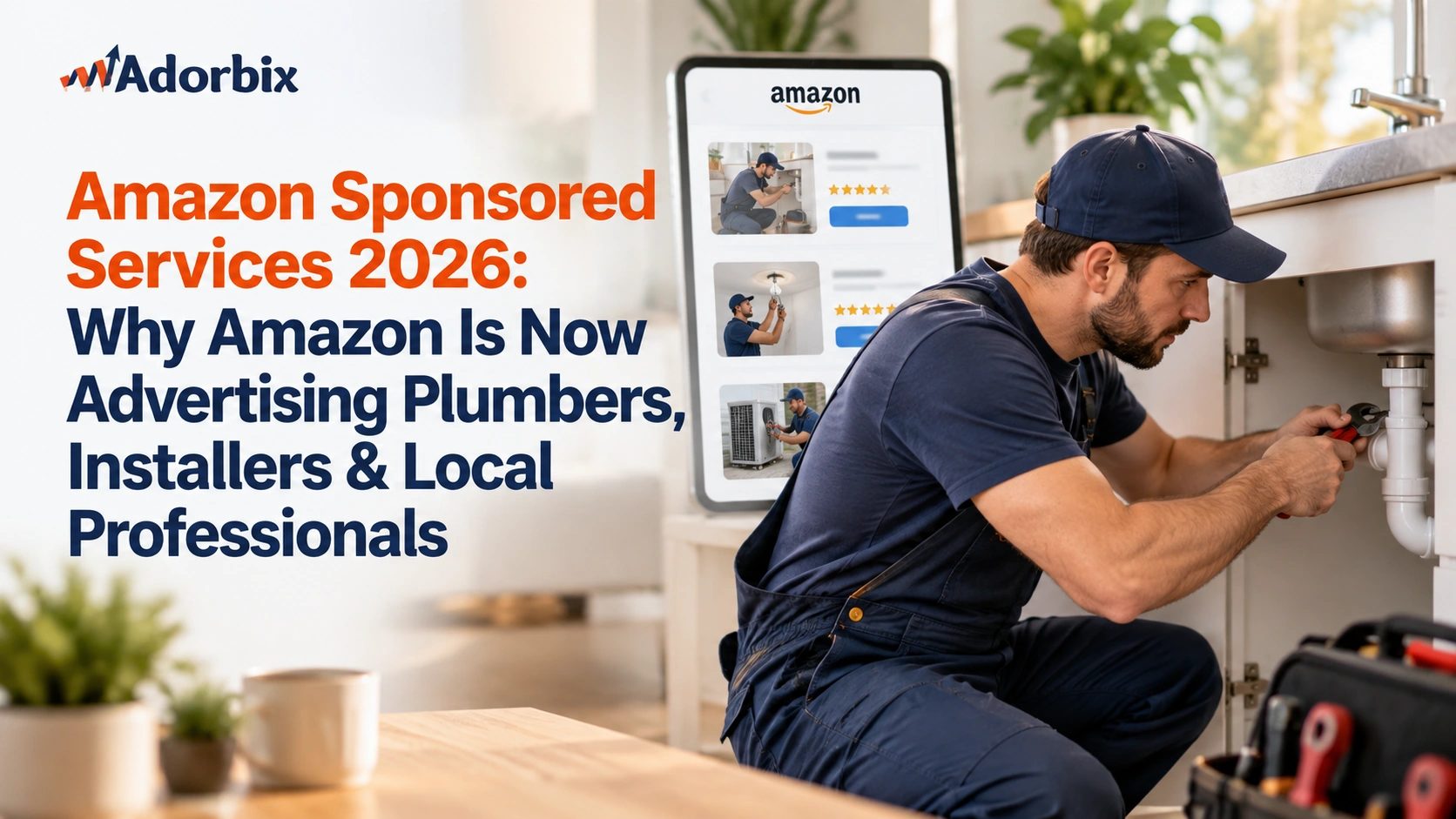
Amazon Sponsored Services 2026: Why Amazon Is Now Advertising Plumbers, Installers & Local Professionals
Amazon advertising has historically been built around selling products.
A customer searches for a faucet.
A Sponsored Product appears.
The shopper buys the faucet.
Amazon's new Sponsored Services format extends that journey one step further:
Who is going to install it?
At unBoxed 2026, Amazon introduced Sponsored Services, a new performance-advertising product designed to connect shoppers with local and online service providers at moments when Amazon can infer that they may need professional help. Amazon's examples include plumbers, electricians, landscapers, restaurants and beauty salons, with additional service verticals expected over time. Amazon Ads
The most interesting part isn't simply that Amazon is now displaying local-service ads.
It's where and when those ads appear.
Sponsored Services can surface when a shopper searches for or purchases something related to a service need—for example, showing a local plumber after someone buys a kitchen faucet. Ads can appear on Amazon product detail pages, order-confirmation pages and package-tracking pages, turning the product transaction into a trigger for a potentially valuable service lead. Amazon Ads
At Adorbix, we see the strategic shift like this:
PRODUCT INTENT → SERVICE INTENT → LOCAL LEAD → CUSTOMER OUTCOME → MEASURABLE ROI
Amazon is no longer stopping at:
“What product does this customer want?”
It is increasingly asking:
“What will this customer need next?”
What Exactly Is Amazon Sponsored Services?
Sponsored Services is Amazon Ads' new advertising solution for businesses selling services rather than—or in addition to—physical products.
Amazon says the product is designed for local and online providers such as:
- plumbers,
- electricians,
- landscapers,
- restaurants,
- beauty salons,
with additional categories expected to be added. Amazon Ads
Instead of optimizing solely toward product clicks or ecommerce orders, Sponsored Services can drive actions such as:
Quote requests
Phone calls
and, in some experiences:
Food ordering. Amazon Ads
That makes it a very different advertising model from Sponsored Products.
The advertiser is not necessarily trying to sell an ASIN.
They are trying to generate a service outcome.
Why Amazon Is Entering Local Services Advertising
Amazon already owns a highly valuable moment in the consumer journey:
The purchase.
But many purchases create another need immediately afterward.
Buy:
Kitchen faucet
and you may need:
Plumber.
Buy:
Ceiling fan
and you may need:
Electrician or installer.
Purchase certain home products and the natural next step may involve:
Assembly
installation
cleaning
repair
or:
professional maintenance.
Historically, that customer often leaves Amazon and goes somewhere else to find the service provider.
They may use:
Google.
Yelp.
Local directories.
Maps.
Social media.
Amazon's Sponsored Services product attempts to capture that next stage before the shopper exits Amazon's ecosystem. Amazon Ads
That's the strategic opportunity.
Amazon Is Targeting the Moment the Need Is Created
Most local-service advertising starts when the consumer explicitly searches:
“Plumber near me.”
At that point, multiple businesses are fighting for the same lead.
Amazon has something different:
Product context.
If Amazon knows a shopper just bought a faucet, it has a strong signal that installation may be relevant.
That allows Sponsored Services to appear before the shopper necessarily performs a separate service search.
Amazon calls these high-intent moments and says its system uses AI-driven intent detection to match service providers with customers when their shopping or conversational behavior suggests a defined need. Amazon Ads
That could make the lead substantially different from ordinary display advertising.
The customer is not being shown a random plumber ad.
They may have just purchased the thing that needs plumbing work.
Where Sponsored Services Ads Can Appear
Amazon says Sponsored Services placements can appear across several important customer touchpoints.
That includes:
Product Detail Pages
A customer evaluating a relevant product may also see an associated professional service opportunity.
Order Confirmation Pages
After completing the purchase, the customer can be shown a service relevant to the product they just bought.
Package Tracking Pages
Amazon can continue presenting the service while the customer's product is on its way. Amazon Ads
These are fascinating placements because they extend advertising past the transaction itself.
Normally, advertisers focus intensely on getting the purchase.
Amazon is now monetizing the period after purchase too.
Why Order Confirmation Could Be an Extremely Valuable Placement
Think about customer psychology.
Before the purchase:
“Should I buy this faucet?”
After the purchase:
“Who's installing this faucet?”
The need has changed.
A Sponsored Services ad shown during the second moment may therefore encounter far less ambiguity.
The customer has already committed to the product.
Now they need the complementary service.
For advertisers, that potentially creates a high-intent lead environment.
At Adorbix, we'd think about this as:
TRANSACTION DATA → NEXT-NEED PREDICTION → SERVICE LEAD
That's a fundamentally different funnel from traditional PPC.
Amazon Is Working With Yelp
Amazon's first major Sponsored Services partnership is with Yelp.
Amazon says Yelp serves as the anchor partner for home and local services, bringing its network of local businesses and review data into the Sponsored Services ecosystem. Yelp says its platform includes millions of local businesses backed by more than 300 million reviews. Amazon Ads
Through that partnership, shoppers can potentially connect with service businesses such as:
Plumbers
Electricians
Landscapers
Home cleaners
Roofers
Movers
and other eligible local professionals. Amazon Ads
For Amazon, Yelp solves a major supply problem.
Amazon knows when the customer may need help.
Yelp already has a deep directory of businesses capable of providing it.
The Yelp Rollout Is Narrower Than the Long-Term Sponsored Services Vision
This distinction is important.
Amazon says Sponsored Services is available now for Yelp advertisers in eligible U.S. home and auto services categories. Amazon Ads
Separately, Amazon's broader Sponsored Services launch documentation says the product is designed for categories including home services, restaurants and other service providers, with more verticals coming over time. Broader programmatic access through Amazon's Unified API is slated for Q4 2026, with Amazon Ads Console access expected in 2027. Amazon Ads
So sellers and agencies should avoid interpreting the announcement as:
“Every plumber, restaurant and salon can log into Amazon Ads today and create one.”
The rollout has multiple access paths and is still developing.
Sponsored Services Isn't Really PPC in the Traditional Sense
This is another major difference.
Sponsored Products commonly use a cost-per-click model.
Sponsored Services introduces CPO—Cost Per Outcome—bidding. Amazon Ads
That means advertisers can optimize around a defined business outcome rather than merely buying clicks.
Potential outcomes can include:
Call
Quote request
Order
or another service action supported by the vertical.
This brings the media-buying model closer to:
Pay for valuable customer actions.
For local businesses, that is often more meaningful than CPC.
Why Cost Per Outcome Could Change Local Advertising Economics
Imagine a plumbing company.
Traditional campaign:
Spend: $1,000
Clicks: 200
CPC: $5
But only:
10 people actually request quotes.
The true acquisition metric isn't $5.
It's:
$100 per quote.
Sponsored Services puts that outcome-level thinking closer to the campaign structure itself.
Amazon says advertisers will be able to track metrics including:
Impressions
Clicks
Outcomes
CTR
Outcome Rate
Cost Per Outcome
Spend
and:
Outcome Type. Amazon Ads
For performance marketers, that's the much more useful dashboard.
An Outcome Still Isn't the Same as a Profitable Customer
This is where Adorbix would add another layer.
Suppose:
Cost per quote = $35.
Excellent?
Not necessarily.
What percentage of quotes convert into customers?
What is average job value?
What's gross margin?
What's repeat rate?
Suppose:
100 quote requests
×
20% close rate
=
20 customers.
At $35 per quote:
$3,500 lead spend.
Your true customer-acquisition cost becomes:
$175.
If average contribution per job is:
$500,
that may work beautifully.
If average contribution is:
$120,
it doesn't.
The correct funnel is:
CPO → CLOSE RATE → CUSTOMER ACQUISITION COST → JOB VALUE → CONTRIBUTION
Amazon controls the ad.
The business still has to close the lead profitably.
Sponsored Services Includes Conversational Lead Qualification
Amazon has added another interesting layer:
Conversational advertising.
Sponsored Services can include an in-ad conversational experience that helps qualify what the shopper needs before passing the outcome to the business. Amazon says the system can use product and search context plus auto-populated customer information to reduce friction. Amazon Ads
That means instead of:
Click ad → external landing page → fill form → submit
the experience can increasingly happen inside Amazon.
Amazon says shoppers can call providers directly or submit a quote request without leaving the Amazon experience. Amazon Ads
That could materially improve lead completion.
Every extra step normally loses some customers.
Amazon is trying to remove those steps.
This Is Agentic Advertising, Not Just Another Banner Ad
Amazon described Sponsored Services during unBoxed as conversational and agentic. Amazon Ads
That's important.
Traditional advertising says:
“Here is an ad. Click if interested.”
Agentic advertising increasingly says:
“Tell me what you need. I'll help complete the task.”
For Sponsored Services, that task could be:
Find the professional
qualify the need
request the quote
or potentially:
complete the order.
The ad becomes part media placement, part service interface.
That may become a much larger Amazon Ads theme over the next several years.
Alexa+ Expands the Opportunity Beyond Product Pages
Amazon's launch materials also show Sponsored Services concepts inside Alexa+ conversational experiences.
One example involves someone asking Alexa+ to help order Italian food.
The interface can present sponsored restaurant results and move through ordering without requiring the customer to begin with a standard Amazon search page. Amazon Ads
That suggests Sponsored Services can eventually address more than:
post-product installation.
It can also capture needs expressed conversationally:
“Find me a restaurant.”
“I need someone to clean the house.”
“Help me get this installed.”
This brings local advertising into Amazon's broader agentic-shopping strategy.
SERVICE MARKETPLACES → AMAZON DEMAND
That's strategically significant.
Restaurants Show the Product Is Broader Than Home Services
The home-services example is easy to understand.
But Amazon's launch documentation also mentions:
Restaurants
and:
Beauty salons. Amazon Ads
That suggests Amazon's ambition extends well beyond installation.
The underlying model is:
Identify a service need from customer context and connect that need to a provider.
That could potentially expand across many service categories over time.
Amazon has not announced every future vertical, so advertisers should avoid assuming specific categories will definitely launch.
But the platform architecture is clearly broader than plumbers.
Amazon Could Eventually Compete More Directly With Google Local Ads
Google has traditionally been one of the most important channels for local businesses because service intent is often expressed through search.
Amazon now brings a different kind of signal.
Google might know:
Customer searched for “plumber.”
Amazon can potentially know:
Customer just purchased a faucet.
Both are valuable.
They represent different points in the intent journey.
The strongest local-service marketing strategy may eventually include both:
search-generated demand
and:
commerce-generated demand.
For agencies, Amazon Sponsored Services could therefore become another performance channel rather than a replacement for existing local advertising.
Sponsored Services Could Also Compete for Yelp's Own Demand—But Yelp Wins Too
The partnership is strategically interesting because Amazon could theoretically compete with local discovery platforms.
Instead, Amazon and Yelp are cooperating.
Amazon contributes:
transactional intent.
Yelp contributes:
local-business supply and reputation.
Both can participate in a customer journey that might otherwise begin on another search platform.
That makes the partnership less about one company replacing the other and more about combining complementary data and distribution.
Privacy and Customer Trust Matter
Sponsored Services uses customer context to identify likely service needs.
That can be useful.
It can also feel intrusive if relevance is poor.
Imagine buying an unrelated product and immediately receiving a service recommendation that seems random.
Amazon therefore needs the intent-detection system to be highly accurate.
The best Sponsored Services experience should feel like:
“That's useful—I actually need that.”
not:
“Why is Amazon showing me this?”
Relevance becomes part of customer trust.
That gives AI intent detection an important responsibility.
What Local Businesses Should Prepare Now
Service businesses interested in Sponsored Services should get their operating foundation ready before focusing on media.
First, define:
Services offered.
Then:
Geographic service area.
Then:
Average job value.
Then:
Gross/contribution margin.
Then:
Acceptable acquisition cost.
Then build:
Fast CRM follow-up.
Without those basics, even a strong Amazon lead stream can become inefficient.
What Amazon Product Brands Should Prepare
Brands selling products with natural service requirements should take a different approach.
Audit your catalog for products involving:
installation
assembly
professional setup
maintenance
or:
repair.
Then ask:
Could easier access to a professional service remove a purchase objection?
If yes, monitor how Amazon expands Sponsored Services around your category.
Brands may not need to buy Sponsored Services themselves to benefit from the customer-experience improvement.
The Adorbix Local-Commerce Framework
At Adorbix, we'd approach this new Amazon channel through five connected layers.
DEMAND SIGNAL
Identify which Amazon behaviors create genuine service intent.
↓
SERVICE PROFILE
Make sure the business communicates:
service,
coverage area,
value,
and availability clearly.
↓
CAMPAIGN ECONOMICS
Set an acceptable:
Cost Per Outcome.
↓
CRM & SALES
Ensure leads are:
delivered,
contacted,
qualified,
and closed quickly.
↓
PROFITABILITY
Measure:
LEAD → CUSTOMER → JOB VALUE → CONTRIBUTION
Amazon Ads can optimize the media.
Adorbix connects the media to the business outcome.
How Adorbix Can Help With Sponsored Services
Sponsored Services creates a new advertising workflow that combines:
Amazon Ads,
local intent,
lead generation,
CRM,
and performance measurement.
Adorbix can help businesses and agencies with:
Campaign Strategy: Determine where Sponsored Services fits relative to Google, Meta and other lead-generation channels.
Service Profile Optimization: Ensure categories, service descriptions and coverage areas accurately reflect the business.
CPO Strategy: Set outcome targets based on real customer-acquisition economics.
CRM Integration Planning: Make sure Amazon leads reach the correct sales or service team rapidly.
Lead Quality Analysis: Go beyond quote volume and measure actual revenue.
Reporting: Connect Amazon outcomes to closed customers and job value.
Profitability: Determine which services, territories and campaigns deserve more budget.
Our goal would not be:
Generate the maximum number of quotes.
It would be:
Generate the maximum profitable service demand.
A Practical Sponsored Services Pilot
A local service business should start narrowly.
Choose:
One service.
One geography.
One clear outcome.
For example:
Kitchen plumbing
in:
one metro area
optimized around:
quote requests.
Track:
Impressions
Outcomes
CPO
Lead response time
Quote-to-job conversion
Revenue
Contribution
After several weeks, compare Sponsored Services with your other lead channels.
Then decide whether to:
SCALE → EXPAND TERRITORY → ADD SERVICES → PAUSE
based on actual customer economics.
Sponsored Services Readiness Checklist
Before launching, a service business should know its service area, core services, average job value, contribution margin, acceptable customer-acquisition cost and target CPO.
It should also have a functioning CRM or lead-management process, rapid response coverage and a way to connect Amazon-generated outcomes back to actual booked work.
Without closed-loop reporting, the advertiser may know what a quote costs but not whether Amazon is producing valuable customers.
Frequently Asked Questions
What is Amazon Sponsored Services?
Sponsored Services is Amazon Ads' new performance-advertising solution connecting customers with local and online service providers at moments when Amazon detects a relevant service need. Advertisers can drive outcomes such as quote requests, phone calls and, in certain verticals, ordering. Amazon Ads
When did Amazon announce Sponsored Services?
Amazon announced Sponsored Services at unBoxed 2026 on September 29, 2026. Amazon Ads
Where do Sponsored Services ads appear?
Amazon says the ads can appear on product detail pages, order-confirmation pages and package-tracking pages, while broader conversational experiences can also surface service recommendations in contexts such as Alexa+. Amazon Ads
What businesses can advertise?
Amazon lists service providers such as plumbers, electricians, landscapers, restaurants and beauty salons, with home services among the initial verticals and additional categories expected later. Amazon Ads
What is Amazon's relationship with Yelp?
Yelp is Amazon's anchor partner for home and local services. Sponsored Services can use Yelp's local-business network and review ecosystem to connect Amazon shoppers with eligible providers. Amazon Ads
Is Sponsored Services available now?
Amazon says Sponsored Services is currently available for Yelp advertisers in eligible U.S. home and auto services categories. Broader programmatic access via the Amazon Ads Unified API is slated for Q4 2026, with Ads Console access expected in 2027. Amazon Ads
What bidding model does Sponsored Services use?
Amazon uses Cost Per Outcome (CPO) bidding, allowing advertisers to optimize around defined service outcomes rather than only clicks. Amazon Ads
What metrics are available?
Amazon says reporting can include impressions, clicks, outcomes, CTR, outcome rate, CPO, spend and outcome type. Amazon Ads
Can leads be sent to a CRM?
Yes. Amazon says Sponsored Services' Unified API supports webhook delivery into existing CRM or lead-management systems. Amazon Ads
Can agencies use Sponsored Services?
Yes. Amazon explicitly includes agencies managing portfolios of local service businesses among the eligible advertiser types. Amazon Ads
Can Adorbix help optimize Sponsored Services?
Yes. Adorbix can connect Sponsored Services CPO campaigns with service-profile optimization, CRM workflows, lead-quality measurement and actual customer profitability so businesses evaluate Amazon leads by booked revenue rather than quote volume alone.
Key Takeaways
Amazon Sponsored Services represents a major expansion of what an Amazon advertiser can be.
Amazon is now connecting shoppers not just with:
PRODUCTS
but with:
PROFESSIONALS.
The product uses Amazon shopping and conversational intent to identify moments when customers may need services such as plumbing, electrical work, landscaping, restaurant ordering or other professional support. Amazon Ads
Ads can appear at unusually valuable moments—including after a relevant purchase—on product pages, confirmation pages and package-tracking experiences. Amazon Ads
The current rollout begins in the U.S., with Yelp playing a major role in home and local services.
Amazon is using:
AI intent detection
Conversational experiences
CPO bidding
CRM integrations
to move beyond clicks toward actual customer outcomes. Amazon Ads
For local service providers, that opens an entirely new Amazon acquisition channel.
For Amazon product brands, it creates a new way of thinking about what happens after the product is purchased.
Final Takeaway: Amazon Is Turning Product Purchases Into Service Demand
The most important part of Sponsored Services isn't:
Amazon is showing ads for plumbers.
It's why those plumber ads appear.
Amazon knows someone just purchased a product that may require plumbing work.
That creates a powerful transition:
PRODUCT PURCHASE → SERVICE NEED → LOCAL PROVIDER → CUSTOMER OUTCOME
Historically, Amazon's job largely ended when the package was sold.
Sponsored Services pushes the platform deeper into what the customer is actually trying to accomplish.
They didn't really want:
a faucet.
They wanted:
a working faucet.
They didn't really want:
a ceiling fan in a box.
They wanted:
a ceiling fan installed.
That is why Sponsored Services could become much bigger than another Amazon Ads placement.
At Adorbix, we'd approach the opportunity with the same principle we apply across Amazon performance marketing:
Don't optimize for the platform metric alone.
A cheap click isn't enough.
A cheap quote isn't enough.
The real objective is:
RIGHT CUSTOMER → RIGHT SERVICE → FAST FOLLOW-UP → PROFITABLE JOB
Amazon is getting better at finding the moment when the customer needs help.
Adorbix's role is making sure businesses turn that moment into profitable growth.
