



Sam
Amazon
October 3, 2026
Amazon Full-Funnel Campaigns 2026: One AI Campaign
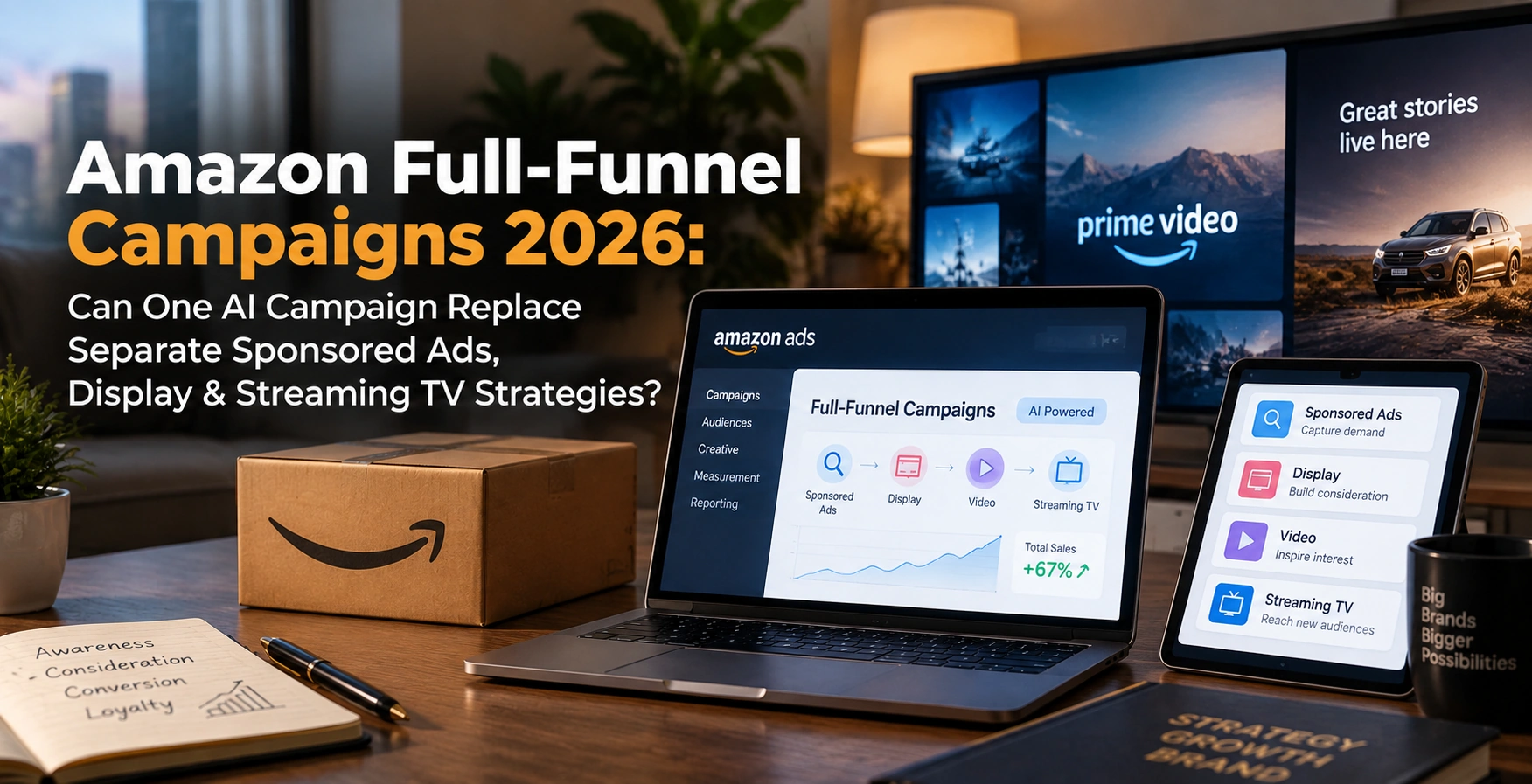
Amazon Full-Funnel Campaigns 2026: Can One AI Campaign Replace Separate Sponsored Ads, Display & Streaming TV Strategies?
Amazon is collapsing one of the biggest walls inside its advertising ecosystem.
Historically, an Amazon brand wanting to cover the entire customer journey might run Sponsored Products for bottom-of-funnel demand, Sponsored Brands for consideration, display for remarketing, online video for awareness and streaming TV to reach entirely new audiences.
Each layer required separate campaign structures, budgets, audiences, creative and optimization decisions.
Amazon's new Full-Funnel Campaigns attempts to coordinate those pieces under a single AI-powered campaign.
Announced at unBoxed 2026, Full-Funnel Campaigns is now available in U.S. open beta for advertisers selling on Amazon. Advertisers provide a few strategic inputs—such as the products they want to promote, their overall budget and an optional ROAS threshold—and Amazon's AI selects formats, allocates budget across funnel stages, finds audiences using Amazon shopping signals and continuously optimizes toward total sales growth. Amazon Ads
The result is a fundamentally different way of thinking about Amazon advertising:
ONE OBJECTIVE → ONE BUDGET → MULTIPLE AD FORMATS → ONE OPTIMIZATION ENGINE
At Adorbix, we would not interpret this as the end of Sponsored Products specialists, DSP strategy or human campaign management.
We'd interpret it as a shift in where human expertise creates value.
The platform increasingly handles orchestration.
Brands still need to define:
What should be optimized?
Which products deserve investment?
What margin must be protected?
How much inventory can support the demand?
And is the campaign generating incremental profit—or simply claiming credit for sales that would have happened anyway?
What Exactly Are Amazon Full-Funnel Campaigns?
Full-Funnel Campaigns are a new campaign type inside Amazon Ads Agent, Amazon's unified AI-first advertising environment.
Amazon Ads Agent now brings together three major campaign categories:
Sponsored Ads
Display, Video and Audio
Full-Funnel Campaigns. Amazon Ads
The Full-Funnel Campaign is specifically designed to combine:
- sponsored ads,
- display,
- online video,
- and streaming TV
inside one coordinated campaign.
Rather than building each format independently, the advertiser provides the business inputs and allows Amazon AI to coordinate how those formats work together. Amazon Ads
That is what makes the launch significant.
Amazon is moving from:
multiple campaigns representing different funnel stages
toward:
one campaign that understands those stages as parts of the same customer journey.
What Does the Advertiser Actually Provide?
Amazon says the setup begins with a small number of strategic inputs.
The advertiser chooses:
Products
Budget
and, optionally:
A ROAS threshold. Amazon Ads
From there, Amazon's AI handles much of the media orchestration.
That includes:
- choosing advertising formats,
- allocating budget across funnel stages,
- reaching audiences using Amazon first-party shopping signals,
- continuously optimizing toward sales growth,
- and helping generate additional creative where needed. Amazon Ads
Amazon says built-in creative tools can also help advertisers produce and approve new images and TV-ready video directly within the campaign workflow. Amazon Ads
For smaller sellers, that lowers several major barriers at once:
Media planning.
Audience creation.
Budget allocation.
Creative production.
Why This Is Different From Simply Running More Ads
A seller could already run:
Sponsored Products.
Sponsored Brands.
Display.
DSP.
Streaming TV.
The innovation is not that these formats suddenly exist.
The innovation is that Amazon's AI can now allow them to share signals and optimization logic inside one coordinated campaign.
Amazon specifically argues that this improves the relationship between:
demand generation
and:
demand capture.
For example, a streaming TV ad may expose someone to the brand.
Later, that shopper searches for the product.
A sponsored ad captures that intent.
Traditionally, those campaigns might operate separately.
Full-Funnel Campaigns tries to understand them as one system. Amazon Ads
That has major implications for budget allocation.
The Traditional Amazon Advertising Funnel
A conventional Amazon growth strategy might look like:
Streaming TV
Create awareness.
↓
Display / Online Video
Build consideration.
↓
Sponsored Brands
Capture category and brand interest.
↓
Sponsored Products
Capture high-intent searches.
↓
Product Detail Page
Convert.
Every layer can work.
The difficulty is deciding:
How much budget belongs in each layer?
If Sponsored Products has the strongest ROAS, teams often push more money toward Sponsored Products.
That can work until the brand runs out of existing demand to capture.
Full-funnel advertising tries to solve that problem by investing in both:
today's shoppers
and:
tomorrow's shoppers.
Amazon AI Can Move Budget Across the Funnel in Real Time
This may be the most important operational change.
Amazon says its AI dynamically allocates the campaign's budget across funnel stages based on performance. Amazon Ads
Instead of manually deciding:
60% Sponsored Ads
20% display
20% streaming TV
the advertiser can give Amazon one budget and allow the system to decide where that next dollar is most useful.
That could reduce one of the hardest questions in full-funnel planning:
Should we spend more creating demand or capturing demand?
Amazon is essentially offering to make that decision continuously.
But there is an important catch.
Amazon can optimize the advertising objective.
It does not automatically know every constraint inside your business.
The AI Does Not Know Your Full Product Economics
Imagine Amazon sees Product A producing excellent conversion.
It allocates more budget toward that product.
But Product A has:
9% contribution margin.
Product B converts slightly less efficiently but has:
34% contribution margin.
Which product deserves the next advertising dollar?
Advertising data alone may say:
Product A.
Business economics may say:
Product B.
At Adorbix, we'd therefore place a profitability layer above the AI.
The operating logic becomes:
AMAZON AI OPTIMIZATION + ADORBIX BUSINESS GUARDRAILS
Amazon can optimize media.
The brand still defines what profitable growth means.
The Optional ROAS Threshold Is Important
Amazon allows advertisers to provide an optional ROAS threshold when setting up Full-Funnel Campaigns. Amazon Ads
That gives the advertiser a way to add a performance constraint.
But ROAS itself is not the same as profitability.
Suppose:
Product A
ROAS = 5.0
Margin before advertising = 15%
Product B
ROAS = 3.5
Margin before advertising = 45%
Product B could generate substantially more contribution even with the lower advertising ROAS.
That is why Adorbix would calculate:
Product margin
↓
Break-even advertising level
↓
Acceptable campaign economics
before setting the campaign guardrail.
Don't choose the ROAS target because:
“4x sounds healthy.”
Choose it because the product economics support it.
Amazon Says Beta Results Were Strong
Amazon reports encouraging early results.
Across Full-Funnel Campaign beta advertisers, Amazon says campaigns produced:
67% higher Long-Term ROAS
compared with the blended performance of the same formats configured independently.
Amazon also reports:
29% lower cost per new-to-brand purchase. Amazon Ads
Those results came from Amazon's internal beta data between June and August 2026.
They are useful signals.
They are not guarantees.
Amazon explicitly notes that individual advertiser performance may vary. Amazon Ads
Brands should therefore use these numbers as:
a reason to test,
not:
a forecast for their own account.
What Is Long-Term ROAS?
Amazon is introducing a more forward-looking way to judge full-funnel media.
Traditional ROAS looks roughly like:
Attributed revenue ÷ ad spend.
But upper-funnel advertising may generate customers whose value unfolds later.
Amazon's Long-Term Sales metric attempts to account for both immediate purchases and the estimated future value associated with new-to-brand customer actions over a 12-month horizon. Amazon Ads
Full-Funnel Campaigns can therefore be analyzed using Long-Term ROAS, not only immediate campaign revenue.
That is strategically important.
A campaign that acquires a valuable new customer may deserve more investment than one that simply retargets loyal buyers who were likely to purchase anyway.
New-to-Brand Becomes a Much More Important Metric
Full-Funnel Campaigns are designed partly around finding customers who have not purchased from the brand before.
That means sellers should pay attention to:
New-to-brand sales.
New-to-brand customers.
Cost per new-to-brand purchase.
These metrics help answer:
Is the advertising actually expanding the customer base?
rather than:
Is it repeatedly advertising to people who already know us?
Amazon highlighted Canine Naturals as an early user and reported that 41% of sales from its Full-Funnel Campaign activity came from new-to-brand customers. Amazon Ads
Again, that is one advertiser example.
But it illustrates the core purpose of the campaign type.
Can Full-Funnel Campaigns Replace Sponsored Products?
Not exactly.
Amazon explicitly says Full-Funnel Campaigns can run alongside existing campaigns, allowing brands to add reach and sales without rebuilding their current strategy. Amazon Ads
That is crucial.
If you already have:
highly optimized exact-match Sponsored Products campaigns,
you do not necessarily need to delete them.
If your Sponsored Brands campaigns are working:
keep them.
If your DSP remarketing architecture is sophisticated and profitable:
don't dismantle it simply because a new campaign type launched.
The smartest initial use is likely:
ADD → TEST → COMPARE → CONSOLIDATE ONLY IF PROVEN
not:
REPLACE EVERYTHING IMMEDIATELY
When Full-Funnel Campaigns Could Replace Separate Strategies
There are some advertisers for whom consolidation may eventually make sense.
A smaller brand might currently have:
- basic Sponsored Products,
- no dedicated DSP team,
- limited video experience,
- little audience planning,
- and a relatively lean marketing team.
For that advertiser, Full-Funnel Campaigns could provide access to sophisticated media orchestration without requiring multiple specialist teams.
Amazon's broader mission is clearly to make full-funnel advertising accessible to brands that previously lacked the expertise or resources to manage it manually. Amazon Ads
That could be transformational for mid-market Amazon sellers.
Larger Brands May Still Want More Control
Enterprise brands face a different problem.
They may already have:
- custom audience strategies,
- AMC analysis,
- programmatic deals,
- advanced frequency controls,
- detailed media budgets,
- brand-lift measurement,
- custom creative sequencing.
Those teams may not want Amazon deciding every media allocation.
For them, Full-Funnel Campaigns could still be useful as:
a testing layer,
incremental media engine,
or:
benchmark against manually structured campaigns.
The best question isn't:
AI or humans?
It's:
Which decisions should AI handle, and which decisions create enough strategic value to remain manual?
Full-Funnel Campaigns vs. DVA+
Amazon announced Full-Funnel Campaigns and DVA+ at the same time, and the two should not be confused.
DVA+ combines:
- display,
- online video,
- streaming TV,
- and audio
inside one programmatic campaign.
Full-Funnel Campaigns go further by coordinating Sponsored Ads with broader media, connecting demand creation and demand capture. Amazon Ads
Think of it this way:
DVA+
= unified non-search media.
Full-Funnel Campaigns
= search + non-search media working together.
For an Amazon seller, Full-Funnel Campaigns are therefore closer to a complete customer-acquisition system.
Creative Is Generated Inside the Campaign Workflow
One of the biggest barriers to full-funnel advertising has always been creative.
Sponsored Products can run using product assets.
Streaming TV cannot.
Video requires production.
Display needs multiple formats.
Amazon says Full-Funnel Campaigns include built-in tools that help advertisers generate:
images
and:
TV-ready video
within the campaign workflow. Amazon Ads
This dramatically lowers the operational barrier.
But at Adorbix, generated creative would still pass through human review.
We would check:
- product accuracy,
- brand consistency,
- claims,
- visual quality,
- customer relevance,
- and conversion potential.
AI can generate assets quickly.
It cannot automatically know whether the message is strategically right.
Listing Conversion Becomes Even More Important
Full-funnel media can create more traffic.
That doesn't guarantee more efficient sales.
If your listing has:
- weak main images,
- poor reviews,
- unclear bullets,
- bad pricing,
- weak A+ Content,
- inventory problems,
then investing in streaming TV or display may simply send more customers into a weak buying experience.
At Adorbix, we'd establish:
RETAIL READINESS BEFORE MEDIA EXPANSION
before scaling any full-funnel strategy.
A good upper funnel amplifies a good lower funnel.
It does not repair one.
Inventory Must Be Part of Full-Funnel Planning
This is another area AI advertising systems may not fully solve.
Suppose Full-Funnel Campaigns successfully creates a 40% sales lift.
Excellent.
Unless the hero ASIN has only:
12 days of inventory.
Now advertising success creates:
a stockout.
That can damage:
- organic momentum,
- customer experience,
- PPC performance,
- future revenue.
Before launching, Adorbix would connect:
Expected media scale
with:
Inventory days of cover
and:
Replenishment lead time.
Advertising should never scale faster than the supply chain can support.
Full-Funnel Measurement Requires More Than ACoS
Sponsored Products often lives inside an ACoS framework.
Full-funnel campaigns require more.
Useful metrics can include:
Immediate ROAS
Long-Term ROAS
New-to-brand percentage
Cost per new-to-brand purchase
Total sales
Branded search
Reach
Frequency
and:
Contribution profit.
No single metric tells the complete story.
At Adorbix, we'd build a scorecard around:
ACQUISITION + INCREMENTALITY + ECONOMICS
rather than forcing upper-funnel media into a Sponsored Products reporting framework.
TACoS Becomes More Useful
Full-funnel campaigns can influence sales that do not necessarily show up as straightforward last-click advertising conversions.
Someone may:
see streaming TV,
remember the product,
search the brand two days later,
and buy organically.
That is one reason TACoS can remain useful as a business-level signal.
If advertising investment rises but:
total Amazon sales rise faster,
the account may be becoming more efficient overall.
But TACoS does not prove causation.
Use it alongside:
- branded search,
- organic sales,
- new-to-brand,
- AMC analysis,
- and controlled testing.
The Adorbix Full-Funnel Framework
At Adorbix, we'd evaluate Full-Funnel Campaigns through six stages.
1. RETAIL READINESS
Confirm:
listing quality,
inventory,
reviews,
price,
and margin.
2. ECONOMICS
Calculate:
break-even advertising levels,
target contribution,
and acceptable ROAS.
3. OBJECTIVE
Decide whether the goal is:
customer acquisition,
total sales,
or broader brand growth.
4. LAUNCH
Use Amazon's AI for:
format selection,
audience orchestration,
budget allocation,
and creative support.
5. MEASURE
Track:
new-to-brand,
Long-Term Sales,
total sales,
and incrementality.
6. PROFIT
Connect the advertising result back to:
CONTRIBUTION MARGIN
That's how an AI campaign becomes a business strategy.
How Adorbix Can Help Brands Use Full-Funnel Campaigns
Amazon is simplifying the mechanics.
Adorbix focuses on the decisions around those mechanics.
PPC Strategy: Protect the Sponsored Products and Sponsored Brands campaigns already generating profitable demand.
Full-Funnel Setup: Decide which ASINs and budgets are appropriate for AI-managed expansion.
Creative: Review and improve generated display and streaming assets.
Listing CRO: Ensure additional traffic lands on PDPs designed to convert.
Inventory: Protect hero products from advertising-driven stockouts.
Measurement: Evaluate new-to-brand, Long-Term ROAS, total sales and incremental contribution.
Profitability: Determine whether Amazon's AI is creating more profitable customers—not merely more attributed revenue.
The objective isn't:
“Let Amazon run everything.”
It's:
“Let Amazon automate the areas where its data and AI create an advantage while Adorbix protects the business economics.”
Who Should Test Full-Funnel Campaigns First?
The strongest candidates are usually brands with:
- established Amazon sales,
- healthy inventory,
- good review depth,
- strong PDP conversion,
- sufficient margin,
- a clear need for incremental customer acquisition.
It may be particularly interesting for brands that have strong Sponsored Products performance but have struggled to expand into streaming TV or DSP because of operational complexity.
Those brands already know the bottom of the funnel works.
Full-Funnel Campaigns can test whether Amazon can profitably expand the top.
Who Should Wait?
Full-Funnel Campaigns probably should not be your first priority if:
- your listings convert poorly,
- inventory is unstable,
- reviews are weak,
- contribution margins are thin,
- Sponsored Products fundamentals are still broken.
Do not use sophisticated media automation to avoid fixing foundational problems.
A brand with 45% ACoS and poor listing conversion does not primarily need streaming TV.
It needs:
a better retail foundation.
A Practical 60-Day Test
Start with one strong ASIN or tightly related product family.
Document the baseline:
- Sponsored Ads spend,
- total sales,
- organic sales,
- new-to-brand,
- TACoS,
- conversion,
- contribution margin.
Launch Full-Funnel Campaigns with a controlled incremental budget.
Do not immediately dismantle existing Sponsored Ads.
Let both systems run long enough to create useful data.
Then compare:
total sales growth,
new customer acquisition,
long-term efficiency,
contribution profit.
The key question is not:
Did Full-Funnel Campaigns report a good ROAS?
It is:
Did adding Full-Funnel Campaigns improve the business compared with what we were already doing?
Full-Funnel Campaign Readiness Checklist
Before launching, confirm:
- Eligible U.S. advertiser selling on Amazon
- Hero ASINs identified
- Healthy inventory
- Strong listing conversion
- Competitive reviews
- Product margin calculated
- Break-even ROAS/ACoS understood
- Existing Sponsored Ads baseline recorded
- New-to-brand baseline recorded
- Total sales baseline recorded
- Creative reviewed
- Incremental test budget defined
- Long-Term ROAS measurement understood
- Post-test contribution analysis planned
If you cannot explain what success looks like before launch, Amazon's automation will not solve that problem for you.
Frequently Asked Questions
What are Amazon Full-Funnel Campaigns?
Full-Funnel Campaigns are an AI-powered campaign type inside Amazon Ads Agent that coordinates Sponsored Ads, display, video and streaming TV under one budget and one optimization engine. Amazon Ads
Who can use Full-Funnel Campaigns?
Amazon says the current open beta is available in the United States to advertisers selling on Amazon, including self-service advertisers, sellers, vendors, agencies, enterprise advertisers and small businesses. Amazon Ads
What inputs does Amazon require?
Advertisers provide the products they want to promote, a budget and optionally a ROAS threshold. Amazon AI handles format selection, audience reach, budget allocation and ongoing optimization. Amazon Ads
Does Full-Funnel Campaigns replace Sponsored Products?
Not necessarily. Amazon says Full-Funnel Campaigns can run alongside existing advertising so brands can add incremental reach without rebuilding their current campaign structure. Amazon Ads
Does Amazon create the video ads?
Amazon says built-in tools can help generate and approve images and TV-ready video when the campaign requires additional creative. Amazon Ads
What results did Amazon see in beta?
Amazon reports that beta advertisers experienced 67% higher Long-Term ROAS and 29% lower new-to-brand cost per purchase versus the blended average of comparable formats managed independently. These are Amazon internal beta results from June–August 2026 and individual performance can vary. Amazon Ads
What is Long-Term Sales?
Amazon describes Long-Term Sales as a metric incorporating immediate conversions plus estimated future value associated with new-to-brand customer behavior over the following 12 months. Amazon Ads
How is Full-Funnel Campaigns different from DVA+?
DVA+ unifies non-search media such as display, online video, streaming TV and audio. Full-Funnel Campaigns also connect Sponsored Ads, allowing demand creation and demand capture to operate within one AI-managed campaign. Amazon Ads
Can Adorbix help manage Full-Funnel Campaigns?
Yes. Adorbix can connect Full-Funnel Campaigns with Sponsored Ads, listing CRO, creative, inventory, AMC measurement and product-level profitability so Amazon AI optimizes within a strategy built around profitable growth.
Key Takeaways
Amazon Full-Funnel Campaigns represent a major change in how Amazon advertisers can manage the customer journey.
Instead of separately managing:
Sponsored Ads,
display,
online video,
and:
streaming TV,
U.S. advertisers selling on Amazon can now bring those formats into one AI-optimized campaign with one budget. Amazon Ads
Amazon's AI can select formats, allocate budget across funnel stages, find audiences using Amazon shopping signals and continuously optimize toward sales growth.
Amazon's early beta data is promising, with reported improvements in both Long-Term ROAS and new-to-brand acquisition cost. Amazon Ads
But automation does not eliminate the need for:
retail readiness
inventory planning
margin discipline
creative quality
and:
incrementality measurement.
The strongest strategy is not necessarily to replace all existing campaigns.
It's to determine where Full-Funnel Campaigns create additional profitable demand beyond what your current Sponsored Ads system already generates.
Final Takeaway: One Campaign Can Replace a Lot of Campaign Management—But It Cannot Replace Strategy
Amazon is simplifying the mechanics of full-funnel advertising.
Instead of asking a brand to manually coordinate:
Search
Display
Video
Streaming TV
Amazon increasingly says:
Give us the products, objective, budget and guardrails. We'll coordinate the media.
That's powerful.
And for many sellers, it could make sophisticated full-funnel advertising accessible for the first time.
But the most important questions still belong to the brand.
Which ASIN deserves investment?
What margin must be protected?
Is inventory ready?
Are customers genuinely new?
Would those customers have purchased anyway?
Did the campaign create contribution profit?
At Adorbix, that's where we would focus.
Amazon can increasingly manage:
THE MEDIA ORCHESTRATION
Adorbix helps manage:
THE BUSINESS LOGIC BEHIND IT
Because the future of Amazon Ads may indeed involve fewer separate campaigns.
But the brands that win will still be the ones making better strategic decisions than their competitors.
