Amazon Branded Conversations 2027: How Brands Can Shape AI Shopping Conversations Inside Alexa
Amazon is changing what it means to advertise during product discovery.
For years, Sponsored Brands worked primarily like a traditional ad format:
A shopper searches.
A branded ad appears.
The shopper clicks.
Then the product page or Brand Store does the selling.
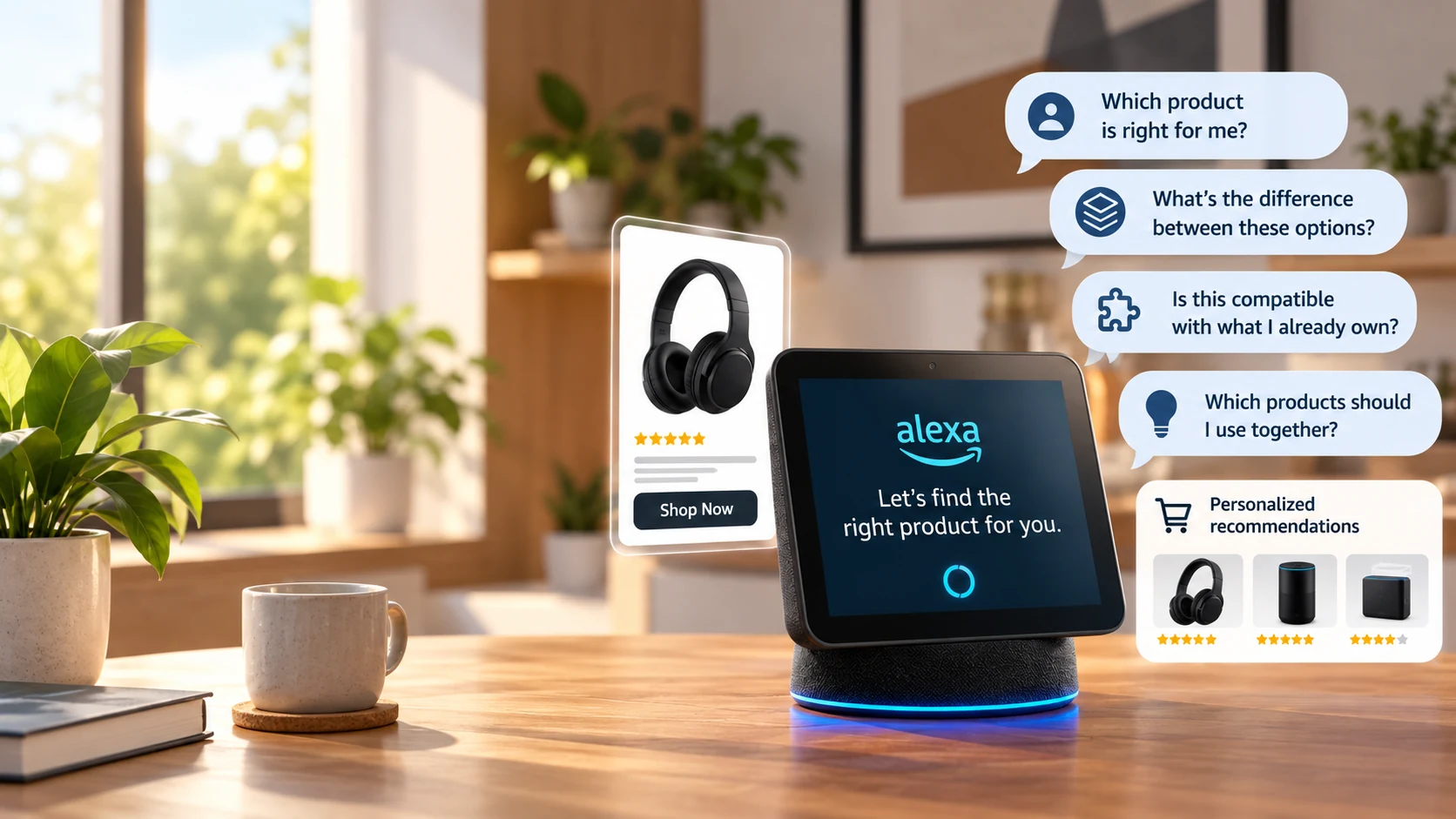
Starting in January 2027, Amazon plans to introduce Branded Conversations, a new Sponsored Brands experience that lets shoppers enter a multi-turn conversation with Alexa for Shopping after interacting with a Sponsored Brands prompt. The conversation can draw on the advertiser's catalog and brand-provided content such as product guides, compatibility information and usage tips, while personalizing recommendations using shopper preferences and purchase history. Amazon Ads
That changes the role of advertising.
The ad is no longer only trying to generate a click.
It can begin answering:
Which product is right for me?
What's the difference between these options?
Is this compatible with what I already own?
Which products should I use together?
At Adorbix, we see the shift like this:
AD → CONVERSATION → PRODUCT EDUCATION → RECOMMENDATION → PURCHASE
The opportunity is significant.
But brands need to understand one thing early:
If AI shopping conversations are powered partly by the information your brand provides, product data quality and brand expertise become advertising assets.
What Is Amazon Branded Conversations?
Branded Conversations is the next evolution of Amazon's existing Sponsored Brands prompts.
Sponsored Brands prompts already allow shoppers to interact with AI-powered product or brand questions that open into Alexa for Shopping.
Branded Conversations takes the experience further.
Amazon says a shopper who taps a prompt on an eligible Sponsored Brands collections ad can enter a multi-turn, brand-informed conversation that uses:
- the advertiser's catalog,
- product guides,
- compatibility information,
- usage recommendations,
- and other brand-supplied expertise. Amazon Ads
The conversation is then personalized according to the shopper's preferences and purchase history.
Amazon's goal is to help customers move from:
browsing several products
to:
understanding the trade-offs
to:
choosing the most appropriate option.
In practical terms, Alexa for Shopping starts behaving more like a knowledgeable in-store product specialist.
When Does Branded Conversations Launch?
Amazon says Branded Conversations will launch in the United States in January 2027. Amazon Ads
At launch, the feature will be available to U.S. endemic Amazon advertisers using Sponsored Brands, excluding authors.
Amazon says the rollout will begin with Sponsored Brands collections campaigns and expand to additional formats later. Amazon Ads
This is therefore not a globally available feature yet.
Brands selling outside the U.S. should watch the rollout rather than assuming the January launch applies to every marketplace.
Do Brands Need to Create a New Campaign?
No.
Amazon says Branded Conversations will be automatically enabled for eligible Sponsored Brands collections campaigns.
Advertisers do not need to create a separate campaign from scratch. Amazon Ads
The system builds on existing:
- campaigns,
- targeting,
- budgets.
Amazon also says advertisers will receive self-service controls through the Ad Console and API.
Those controls include the ability to:
- pause individual Branded Conversations,
- provide campaign-specific inputs,
- view performance reporting,
- opt out at the campaign or account level. Amazon Ads
This is important because it means the conversation layer can sit on top of an existing Sponsored Brands strategy rather than forcing brands into an entirely new advertising architecture.
How Is This Different From Sponsored Brands Prompts Today?
Sponsored Brands prompts already open AI-powered shopping conversations.
Previously, those conversations relied heavily on Amazon's own first-party information from sources such as:
- product detail pages,
- Brand Stores,
- campaign information,
- other Amazon signals. Amazon Ads
Branded Conversations introduces something new:
BRAND-SUPPLIED EXPERTISE
The advertiser can provide additional information that helps Alexa explain what differentiates the brand and its products.
That allows the conversation to move beyond basic product facts.
For example, a skincare brand could help explain:
- which cleanser is better for oily skin,
- which option suits sensitive skin,
- which products are appropriate for beginners,
- how cleansers, serums and moisturizers work together. Amazon Ads
That is far closer to assisted selling than traditional display advertising.
Why This Matters for Complex Products
Branded Conversations should be particularly valuable for products where shoppers struggle to compare options.
Consider categories such as:
Skincare
Consumer electronics
Supplements
Tools
Home improvement
Beauty
Pet products
Appliances
Automotive accessories
These categories often generate questions such as:
Which version do I need?
Is this compatible?
What size should I choose?
What's the difference between Model A and Model B?
What should I buy with this?
A conventional Sponsored Brands ad cannot answer all of those questions.
A multi-turn AI conversation can.
That means conversational ads may create the most value in categories where:
EDUCATION IS PART OF CONVERSION
Compatibility Information Could Become Extremely Valuable
Compatibility is one of the best use cases.
Suppose you sell:
- replacement parts,
- electronics accessories,
- vehicle accessories,
- smart-home devices.
A major customer hesitation may be:
Will this work with the product I already own?
If that information is buried deep in the listing, the shopper may abandon the purchase.
With Branded Conversations, compatibility data can become part of the AI-assisted buying experience.
The customer might ask:
Will this fit my Model X?
And receive a relevant answer during the sponsored conversation.
For Adorbix, this makes compatibility information more than catalog maintenance.
It becomes:
CONVERSION CONTENT
Product Guides Can Become Advertising Inputs
Amazon specifically says brand-provided content can include product guides. Amazon Ads
This gives brands a reason to formalize knowledge that may currently exist only in:
- customer-support documents,
- PDFs,
- product manuals,
- sales-team training,
- internal FAQs.
Imagine a cookware brand.
Instead of simply advertising five pans, the brand could provide guidance explaining:
- which pan is best for searing,
- which is better for induction,
- which is easier for beginners,
- when stainless steel beats non-stick.
The Sponsored Brands conversation can then help shoppers select the right product.
That makes the brand's internal expertise part of the ad experience.
The Best Brands Will Prepare Content Before January
Brands should not wait until January to start thinking about this.
At Adorbix, we would begin building a conversational content library now.
For every priority product family, document:
Who is the product for?
Who is it not for?
What problems does it solve?
How does it differ from nearby products?
What products complement it?
What compatibility limitations exist?
What are the most common customer questions?
What mistakes should buyers avoid?
This information can strengthen:
- Alexa conversations,
- listings,
- A+ Content,
- Brand Stores,
- customer support.
Even if a specific Branded Conversations input is not available until launch, organizing the knowledge now has value.
Reviews and Customer Questions Can Reveal What Alexa Should Explain
The best conversational content usually does not begin with marketing.
It begins with customer confusion.
Review:
- negative reviews,
- product Q&A,
- returns,
- customer-service tickets,
- search terms,
- competitor reviews.
Look for repeated questions.
If customers constantly ask:
Is this waterproof?
then the answer needs to be clearer.
If they ask:
What's included in the box?
add that information.
If reviews say:
I bought the wrong size,
your product-selection guidance probably needs improvement.
At Adorbix, we would use this data to decide which information deserves priority inside AI shopping conversations.
Amazon Says Existing Prompts Are Already Driving Engagement
Amazon says that in early testing, nearly 20% of shoppers who interact with a Sponsored Brands prompt continue the conversation about that brand. Amazon Ads
Amazon also reports that adding prompts to Sponsored Brands ads has produced a 6% increase in conversions in its testing. Amazon Ads
These are Amazon-reported results and should not be treated as guaranteed outcomes for every advertiser.
But they do show that some shoppers are willing to move beyond the initial ad and engage conversationally.
Branded Conversations attempts to deepen that behavior by bringing more brand-specific expertise into the dialogue.
Conversation Quality May Become a New Advertising KPI
Sponsored Brands performance has traditionally been evaluated through measures such as:
- impressions,
- clicks,
- CTR,
- sales,
- ROAS.
Branded Conversations introduces additional questions.
For example:
Did shoppers start the conversation?
How long did they continue?
Which prompts generated meaningful engagement?
Did conversations result in product recommendations?
Did the recommended products convert?
Amazon says advertisers will receive performance reporting in the Ads Console and API. Amazon Ads
The exact reporting structure may evolve closer to launch.
But sellers should prepare for a world where:
CONVERSATIONAL ENGAGEMENT
becomes another stage between impression and purchase.
More Conversation Does Not Automatically Mean Better Advertising
A long conversation can be useful.
It can also mean the customer is confused.
Brands should not assume:
More messages = more success.
The better KPI may be:
Did the conversation help the customer make the right decision?
A conversation that answers one compatibility question and leads to purchase may be more valuable than a ten-message conversation that goes nowhere.
At Adorbix, we would ultimately connect conversational metrics to:
- conversion,
- return rate,
- new-to-brand sales,
- contribution.
Engagement is useful.
Commercial outcome is still what matters.
Branded Conversations Could Improve Cross-Selling
Amazon's skincare example highlights another major opportunity:
complementary products. Amazon Ads
A shopper may enter the conversation looking for:
cleanser.
But the brand can help explain how the cleanser fits into a broader routine involving:
- toner,
- serum,
- moisturizer,
- sunscreen.
That creates a natural path from:
ONE PRODUCT
to:
ONE SOLUTION
This could be particularly valuable for brands with:
- routines,
- systems,
- ecosystems,
- accessories,
- consumable complements.
At Adorbix, we'd identify product families where conversational cross-selling makes genuine sense rather than forcing unrelated recommendations.
Product Portfolio Architecture Becomes More Important
AI shopping assistants need to understand how products differ.
If your catalog contains:
Product A
Product B
Product C
but your own product pages do not clearly explain the difference, Alexa may have weak material to work from.
Brands should build clear product roles.
For example:
Entry level
Best for beginners.
Performance version
Best for advanced users.
Premium version
Best for shoppers prioritizing specific features.
This helps both humans and AI understand the catalog.
At Adorbix, we call this:
PORTFOLIO CLARITY
And conversational commerce makes it more important.
Weak Product Data Could Become an Advertising Problem
If AI uses product data to guide buying decisions, inaccurate information becomes more dangerous.
A bad bullet point today may reduce conversion.
A bad product fact tomorrow could potentially influence an entire AI conversation.
Brands should audit:
- dimensions,
- materials,
- compatibility,
- ingredients,
- usage instructions,
- claims,
- warnings,
- included accessories.
The product truth needs to be consistent across:
PDP
A+ Content
Brand Store
Brand-provided conversation inputs.
The more conversational Amazon becomes, the more expensive data inconsistency becomes.
Brand Storytelling Can Move Closer to the Buying Decision
Branded Conversations is not only about technical information.
Amazon says brands can use the experience to communicate what makes them different and how their products address customer needs. Amazon Ads
That creates an interesting role for brand storytelling.
Instead of telling a generic story such as:
We care about quality.
the brand can provide useful expertise such as:
This product was designed for customers who prioritize X over Y.
That's more persuasive because it helps the shopper make a decision.
The strongest branded AI content will likely feel:
helpful first,
promotional second.
Sponsored Disclosure Still Matters
Amazon says Branded Conversations will be clearly marked as Sponsored inside Alexa for Shopping. Amazon Ads
That's important.
Customers should know when brand-provided information is influencing the conversation.
The trust challenge for advertisers is therefore significant.
The content needs to be:
- accurate,
- useful,
- balanced enough to be credible.
Overly aggressive brand claims may damage trust inside a conversational setting much faster than they would inside a standard banner ad.
At Adorbix, we'd treat every conversational input as:
SALES CONTENT + TRUST CONTENT
at the same time.
Personalization Makes the Experience More Powerful
Amazon says Branded Conversations can personalize the shopping dialogue based on shopper preferences and purchase history. Amazon Ads
That means two customers asking about the same product category may receive different recommendations.
A beginner may receive one product.
An experienced customer may receive another.
Someone who already owns Product A may be shown Product B as a complement.
This is where Amazon's first-party signals create a major advantage.
The conversation does not need to start from zero.
It can potentially understand part of the customer's existing shopping context.
Brands Should Not Try to Control Every Answer
There is a strategic tension here.
Brands provide expertise.
Alexa for Shopping still mediates the experience.
That is healthy.
If Branded Conversations simply repeated advertiser-written scripts, they would become a glorified sales chatbot.
The useful version combines:
brand expertise
with:
Amazon customer context
to help the shopper make a decision.
Brands should focus on providing:
accurate source material,
not:
scripting every possible conversation.
Branded Conversations Could Change Sponsored Brands Strategy
Today, many advertisers build Sponsored Brands around:
- keyword targeting,
- headline,
- image,
- products.
In 2027, a sophisticated campaign may also consider:
What conversation do we want this ad to start?
For example:
Instead of generic headline:
Shop our skincare.
The strategy might center around a prompt such as:
Help me build a daily skincare routine.
Amazon's own example uses this kind of conversational journey. Amazon Ads
That shifts campaign planning from:
AD CREATIVE
to:
AD CREATIVE + CONVERSATION DESIGN
This is a meaningful new discipline.
The Adorbix Branded Conversations Framework
At Adorbix, we would prepare brands through five stages.
1. AUDIT
Identify:
- top customer questions,
- comparison problems,
- compatibility issues.
2. STRUCTURE
Create clear:
- product guides,
- product roles,
- compatibility information,
- usage guidance.
3. OPTIMIZE
Strengthen:
- listings,
- A+ Content,
- Brand Store,
- catalog data.
4. ACTIVATE
Use Sponsored Brands prompts and Branded Conversations on products where education improves conversion.
5. MEASURE
Track:
ENGAGEMENT → RECOMMENDATION → PURCHASE → CONTRIBUTION
rather than conversational engagement alone.
The goal is not simply to get shoppers talking to Alexa.
It's to help qualified shoppers choose confidently.
How Adorbix Can Help Brands Prepare
Branded Conversations sits at the intersection of:
Amazon Ads
SEO
CRO
catalog strategy
and:
AI shopping optimization.
Adorbix can help with:
Customer Question Analysis: Identify recurring objections from reviews, Q&A and support data.
Product Guide Development: Clarify use cases, differences and compatibility.
Sponsored Brands Strategy: Align prompts and products with the right customer questions.
Listing Optimization: Give Amazon's AI cleaner, richer product information.
A+ Content: Build stronger product education across the entire PDP.
Portfolio Strategy: Make product differences easier to understand.
Performance Analysis: Evaluate whether conversations improve conversion and profitable sales.
The objective is not:
Control the AI conversation.
It is:
Give the AI better brand expertise to work with.
A Practical Preparation Plan Before January
Brands should begin with their top Sponsored Brands product families.
For each family, create a one-page internal guide answering:
- ideal customer,
- use case,
- key differentiators,
- comparison between products,
- compatibility,
- complementary products,
- common objections,
- usage tips.
Then compare that guide with your current listing.
Anything important that exists internally but not publicly should be reviewed for potential inclusion in:
- PDP content,
- A+ Content,
- Brand Store,
- Branded Conversations inputs.
By January, the goal should be:
ONE CONSISTENT PRODUCT KNOWLEDGE BASE
across the whole Amazon presence.
Branded Conversations Readiness Checklist
Before launch, confirm:
- Sponsored Brands collections campaigns are active
- Product differences are clearly documented
- Compatibility information is accurate
- Usage instructions are current
- Customer FAQs have been reviewed
- Reviews and returns have been analyzed
- Complementary products are mapped
- Brand Store information is current
- Product attributes are complete
- A+ Content supports product education
- Brand claims are compliant
- Conversation performance will be monitored
- Campaign-level opt-out/pause process is understood
Conversational ads will amplify whatever product knowledge exists.
Make sure that knowledge is worth amplifying.
Frequently Asked Questions
What is Amazon Branded Conversations?
Branded Conversations is an upcoming Sponsored Brands experience that lets shoppers enter multi-turn, brand-informed conversations with Alexa for Shopping after interacting with a Sponsored Brands prompt. Amazon Ads
When does Branded Conversations launch?
Amazon says Branded Conversations launches in the United States in January 2027. Amazon Ads
Who can use it?
Amazon says it will initially be available to all U.S. endemic Amazon advertisers using Sponsored Brands, excluding authors, starting with collections campaigns. Amazon Ads
Do advertisers need to create a separate campaign?
No. Amazon says eligible Sponsored Brands collections campaigns will have Branded Conversations automatically enabled, using existing campaigns, targeting and budgets. Amazon Ads
Can brands provide information to Alexa?
Yes. Amazon says the conversation can use brand-provided content such as product guides, compatibility information and usage tips in addition to catalog data. Amazon Ads
Can advertisers turn the feature off?
Yes. Amazon says brands can opt out at the campaign or account level and pause individual Branded Conversations. Amazon Ads
Where will reporting be available?
Amazon says self-service reporting and controls will be available through the Ad Console and Amazon Ads API. API documentation is expected closer to launch. Amazon Ads
Are conversations labeled as advertising?
Yes. Amazon says Branded Conversations will be clearly marked as Sponsored inside Alexa for Shopping. Amazon Ads
Do Sponsored Brands prompts already work?
Amazon says nearly 20% of shoppers who interact with Sponsored Brands prompts continue the conversation about that brand in early testing. Amazon has also reported a 6% conversion lift from adding prompts in its testing. These are Amazon-reported results, not guaranteed outcomes. Amazon Ads
Can Adorbix help prepare for Branded Conversations?
Yes. Adorbix can connect Sponsored Brands strategy, product guides, listing optimization, A+ Content, customer-question analysis and conversion measurement so brands enter AI shopping conversations with stronger product information and clearer positioning.
Key Takeaways
Amazon Branded Conversations launches in the U.S. in January 2027 and expands Sponsored Brands prompts into a deeper multi-turn Alexa for Shopping experience. Amazon Ads
The conversation can use:
PRODUCT CATALOG DATA
PRODUCT GUIDES
COMPATIBILITY INFORMATION
USAGE TIPS
and personalization from shopper preferences and purchase history. Amazon Ads
Eligible Sponsored Brands collections campaigns will be automatically enabled, with controls available through Ad Console and API.
The opportunity is particularly strong for brands selling products where customers need:
comparison,
education,
compatibility help,
or:
routine-building guidance.
But conversational commerce also raises the cost of weak product information.
If your catalog is unclear, AI shopping conversations can expose that weakness quickly.
Final Takeaway: The Next Amazon Ad May Need to Answer Questions, Not Just Get Clicks
Sponsored Brands used to succeed primarily by getting attention.
Branded Conversations adds another job.
Now the ad may need to begin a useful conversation.
That changes how brands should prepare.
You need more than:
an attractive headline,
strong imagery,
and competitive bids.
You also need:
clear product expertise,
accurate compatibility data,
strong comparisons,
useful guidance,
and:
a well-structured catalog.
At Adorbix, we believe the brands that benefit most from Branded Conversations will be the ones that prepare their product knowledge before the feature arrives.
The winning workflow becomes:
SPONSORED BRAND → SHOPPER QUESTION → BRAND EXPERTISE → ALEXA GUIDANCE → RIGHT PRODUCT → PURCHASE
Amazon's AI provides the conversation.
Adorbix helps make sure your brand gives that conversation something genuinely useful to say.
.webp)