



Sam
Amazon
August 7, 2026
AI Shopping Assistants & Amazon Product Discovery 2026 Adorbix
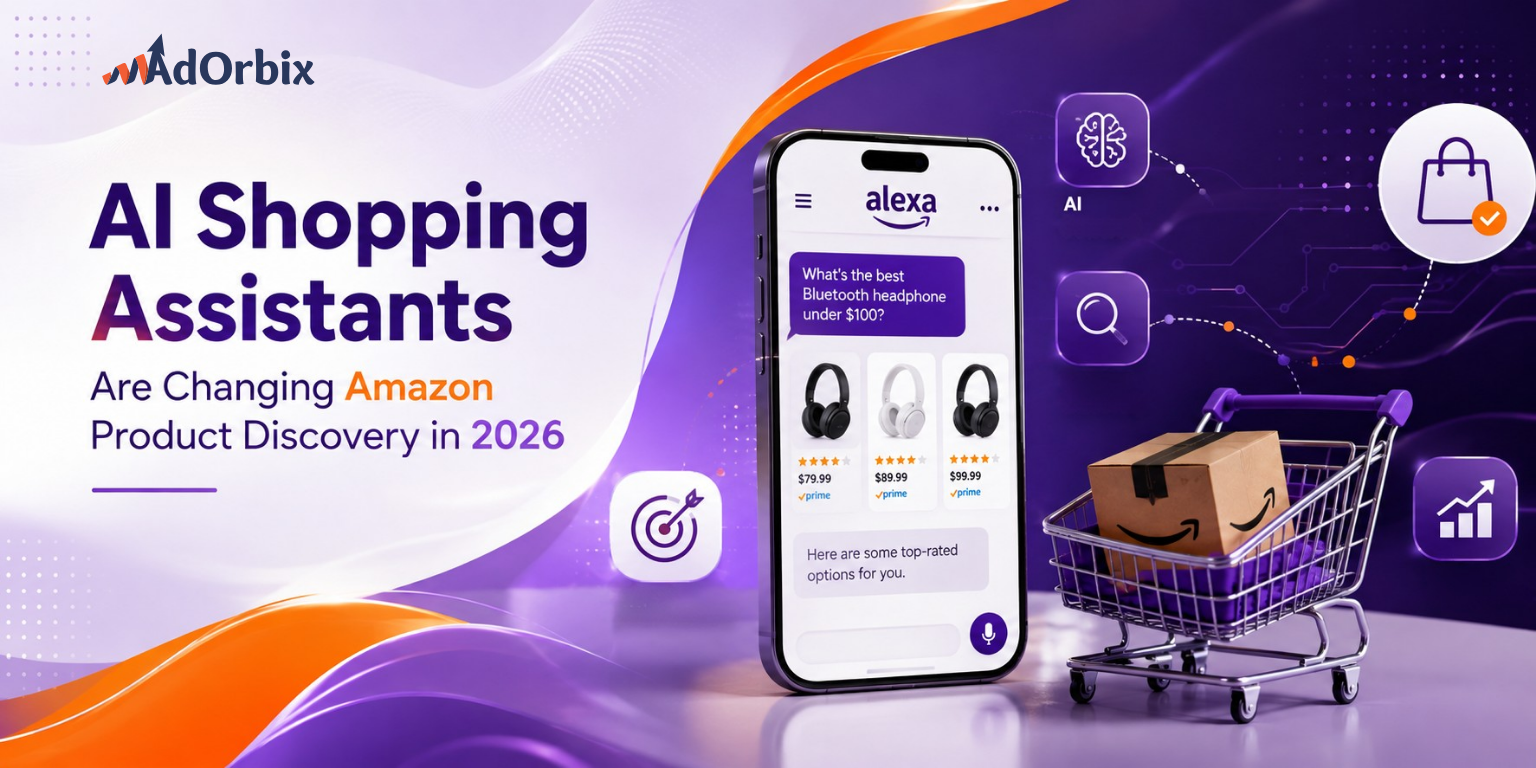
Amazon product discovery is entering a new era.
For years, Amazon sellers focused on optimizing listings around keywords, search volume, and ranking algorithms. Success largely depended on placing the right keywords in titles, bullet points, backend search terms, and product descriptions.
Today, that approach alone is no longer enough.
Artificial intelligence is fundamentally changing how shoppers discover products—not only on Amazon but across the web.
Amazon's Alexa for Shopping (formerly known as Rufus), together with AI platforms like ChatGPT, Perplexity, and Google AI Overviews, is shifting product discovery from keyword matching to intent understanding.
Instead of searching for:
"Adjustable Dumbbells 25 lbs"
Shoppers increasingly ask:
- What's the best adjustable dumbbell set for beginners?
- Which yoga mat is best for hardwood floors?
- Recommend a coffee grinder for espresso under $100.
These conversational queries require AI to understand context rather than simply match keywords.
For Amazon sellers, this represents one of the biggest shifts in ecommerce optimization since the introduction of Amazon's A9 search algorithm.
The Shift from Keyword Search to AI-Powered Shopping
Traditional Amazon SEO focused on keyword relevance.
The system attempted to match shopper queries with listing text.
AI shopping assistants work differently.
Using technologies such as Retrieval-Augmented Generation (RAG) and Amazon's COSMO knowledge graph, Alexa for Shopping interprets customer intent before recommending products.
Rather than asking:
"Does this listing contain the exact keyword?"
The AI asks:
"Which product best solves this customer's problem?"
This means listings must communicate value—not simply contain keywords.
The more clearly Amazon understands your product, the more confidently AI can recommend it.
Why Semantic Search Is Replacing Keyword Stuffing
AI understands relationships between concepts.
For example:
A customer searching for:
"Home gym equipment for beginners"
may receive recommendations for:
- Adjustable dumbbells
- Resistance bands
- Workout benches
- Exercise mats
- Compact storage racks
—even if those exact words never appear together in the search query.
Semantic search connects products through meaning instead of exact wording.
As a result, repetitive keyword stuffing provides less value than comprehensive product information.
Why Product Attributes Matter More Than Ever
One of the biggest changes in AI-driven product discovery is the growing importance of structured product data.
Amazon increasingly relies on attributes such as:
- Material
- Dimensions
- Compatibility
- Certifications
- Ingredients
- Capacity
- Intended use
- Age recommendations
- Installation type
- Product category
These fields help AI understand exactly what your product is—and who it's designed for.
Leaving attributes incomplete limits the information AI can use when deciding whether your product matches a shopper's intent.
Q&A Has Become an AI Training Resource
Many sellers underestimate the value of the Amazon Questions & Answers section.
AI doesn't.
Every answered customer question provides additional context about:
- Product functionality
- Real-world usage
- Compatibility
- Limitations
- Customer concerns
Listings with robust Q&A sections often provide richer contextual information than listings relying only on bullet points.
Our team at Adorbix has observed that products with comprehensive customer questions and detailed answers tend to perform better in AI-assisted product discovery because they answer more shopper intents naturally.
Rather than waiting for customers to ask questions, brands should proactively expand this section with helpful, informative responses.
Lifestyle Content Helps AI Understand Intent
Modern AI doesn't simply evaluate technical specifications.
It also considers context.
Compare these two descriptions:
Version A
Stainless steel water bottle. 32 oz.
Version B
Designed for hiking, commuting, office use, gym workouts, and outdoor adventures. Double-wall insulation keeps drinks cold for up to 24 hours.
The second version provides significantly more contextual information.
Lifestyle content helps AI connect products with real-world scenarios, making recommendations more relevant to conversational searches.
Amazon A+ Content Is Becoming More Valuable
Amazon A+ Content was originally introduced to improve the customer shopping experience.
Today, it serves another important purpose.
Well-structured A+ Content provides AI with:
- Better product explanations
- Use-case scenarios
- Brand context
- Feature relationships
- Comparison information
- Educational content
Rather than treating A+ Content as decorative branding, sellers should view it as structured product knowledge.
The more comprehensive your A+ modules are, the more effectively AI systems can understand your products.
Product Discovery Is No Longer Limited to Amazon
Consumers increasingly begin product research outside Amazon.
Instead of immediately visiting the marketplace, many shoppers ask AI assistants questions like:
- What's the best standing desk under $300?
- Which protein powder is best for beginners?
- Recommend a cordless vacuum for pet hair.
- What's the best ergonomic office chair?
These questions are answered by:
- ChatGPT
- Perplexity AI
- Google AI Overviews
- Microsoft Copilot
- Other AI-powered shopping assistants
These systems gather information from multiple sources, including:
- Brand websites
- Product documentation
- Reviews
- Industry publications
- Shopping data
- Public product information
As a result, Amazon sellers now need visibility beyond Amazon itself.
Welcome to the Era of Generative Engine Optimization (GEO)
Search Engine Optimization (SEO) remains important.
But AI search introduces another discipline:
Generative Engine Optimization (GEO).
Instead of optimizing only for search engines, GEO focuses on making your information easy for AI systems to understand, verify, and reference.
Effective GEO includes:
- Consistent product information
- Clear specifications
- Structured formatting
- Helpful FAQs
- Accurate brand messaging
- Educational content
- High-quality reviews
- Trustworthy website content
Brands that publish reliable information across multiple platforms are more likely to appear in AI-generated shopping recommendations.
How Amazon Sellers Should Optimize Listings for AI Discovery
1. Complete Every Product Attribute
Don't leave important fields blank.
Include:
- Material
- Size
- Certifications
- Compatibility
- Ingredients
- Warranty
- Intended use
- Country of origin
Every completed attribute provides additional context.
2. Expand Product Questions & Answers
Create informative answers to common customer concerns.
Think beyond specifications.
Explain:
- Who the product is for
- How it's used
- Common mistakes
- Care instructions
- Compatibility
- Maintenance
3. Write for Humans First
Natural language consistently outperforms keyword stuffing.
Focus on solving customer problems instead of repeating keywords.
4. Strengthen Your A+ Content
Use:
- Lifestyle imagery
- Comparison charts
- Infographics
- Educational graphics
- Brand storytelling
A+ Content should educate—not simply decorate.
5. Keep Information Consistent Everywhere
Ensure your:
- Website
- Amazon listings
- Product manuals
- Blogs
- Social profiles
all communicate the same product facts.
Consistency improves AI confidence.
What This Means for Amazon Sellers
AI shopping assistants are changing product discovery from a keyword competition into an information competition.
The brands that provide the clearest, richest, and most trustworthy product information will have an increasing advantage.
Success is becoming less about gaming algorithms and more about helping AI understand products the same way customers do.
This trend is expected to continue as conversational commerce grows across ecommerce platforms.
How Adorbix Helps Brands Optimize for AI Search
At Adorbix, we believe Amazon optimization is evolving beyond traditional SEO.
Our team helps brands prepare for AI-powered commerce through:
- Amazon Listing Optimization
- Premium A+ Content Design
- Amazon SEO
- Amazon PPC Management
- Product Attribute Optimization
- Brand Store Design
- GEO (Generative Engine Optimization)
- Conversion Rate Optimization
- Marketplace Growth Strategy
We don't optimize listings for yesterday's algorithm—we build product pages designed for the future of AI-driven shopping.
Frequently Asked Questions
Is Rufus still available?
No.
Amazon integrated Rufus into Alexa for Shopping in 2026, making conversational shopping a broader part of the Alexa ecosystem.
Does AI replace Amazon SEO?
No.
Keyword optimization remains important, but AI increasingly evaluates product meaning, customer intent, and contextual information alongside traditional ranking signals.
Does A+ Content help AI understand products?
While Amazon hasn't stated that A+ Content directly influences AI recommendations, well-structured A+ Content provides richer product context that can support customer understanding and overall listing quality.
What is Generative Engine Optimization (GEO)?
GEO is the practice of structuring content so AI systems can accurately understand, reference, and surface it in AI-generated responses and shopping recommendations.
Should sellers rewrite all their listings?
Not necessarily.
Start by improving product attributes, expanding Q&A sections, strengthening A+ Content, and replacing keyword-heavy copy with clear, customer-focused explanations.
Key Takeaways
- AI shopping assistants are changing how customers discover products on Amazon and across the web.
- Product discovery is shifting from keyword matching to intent understanding.
- Complete product attributes, informative Q&A sections, and strong A+ Content provide AI with better context.
- Brands should optimize for both Amazon SEO and Generative Engine Optimization (GEO).
- High-quality, structured, and trustworthy content is becoming a competitive advantage.
- Sellers who continuously improve their product information will be better positioned as AI-powered shopping continues to grow.
Final Thoughts
The future of Amazon shopping is increasingly conversational.
Customers no longer think in keywords—they ask questions, describe problems, and expect AI to recommend the best solution.
As Alexa for Shopping, ChatGPT, Perplexity, and other AI platforms become central to ecommerce discovery, brands must rethink how they present product information.
The winners won't necessarily be the brands with the longest titles or the most repeated keywords. They'll be the brands that communicate product value clearly, provide complete and structured information, and create content that both shoppers and AI systems can understand with confidence.
At Adorbix, we're helping Amazon brands prepare for this shift through AI-ready listing optimization, Premium A+ Content, Amazon SEO, PPC management, and Generative Engine Optimization (GEO). By combining marketplace expertise with a forward-looking content strategy, we help businesses stay competitive in an AI-first ecommerce landscape.
